UNITED STATES SECURITIES AND EXCHANGE COMMISSION
Washington, D.C. 20549
Form
ANNUAL REPORT PURSUANT TO SECTION 13 OR 15(d) OF THE
SECURITIES EXCHANGE ACT OF 1934
For the fiscal year ended
TRANSITION REPORT PURSUANT TO SECTION 13 OR 15(d)
OF THE SECURITIES EXCHANGE ACT OF 1934
Commission File Number
Registrant
State of Incorporation
I.R.S. Employer Identification Number
,
Address of Principal Executive Offices
/
Registrant’s Telephone Number
Securities registered pursuant to Section 12(b) of the Act:
Title of each class
Trading Symbol(s)
Name of each exchange on which registered
Securities registered pursuant to Section 12(g) of the Act:
None
☐
☑
☐
☑
1934 during the preceding 12 months (or for such shorter period that the Registrant was required to file such reports), and (2) has been subject to
such filing requirements for the past 90 days. Yes
☑
☐
405 of Regulation S-T (§ 232.405 of this chapter) during the preceding 12 months (or for such shorter period that the registrant was required to
submit such files). Yes
☑
☐
or an emerging growth company. See the definitions of “large accelerated filer,” “accelerated filer,” “smaller reporting company” and “emerging
growth company” in Rule 12b-2 of the Exchange Act.
Large accelerated filer
☐
☐
Emerging Growth Company
☑
complying with any new or revised financial accounting standards provided pursuant to Section 13(a) of the Exchange Act.
☐
internal control over financial reporting under Section 404(b) of the Sarbanes-Oxley Act (15 U.S.C. 7262(b)) by the registered public accounting
firm that prepared or issued its audit report.
in the filing reflect the correction of an error to previously issued financial statements.
received by any of the registrant’s executive officers during the relevant recovery period pursuant to §240.10D-1(b).
☐
☐
☑
business day of the Company’s most recent second quarter, was $
Exchange on that date.
DOCUMENTS INCORPORATED BY REFERENCE
2
THE CATO CORPORATION
FORM 10-K
TABLE OF CONTENTS
Page
PART I
Item 1.
Business ..........................................................................................................................
5 – 10
Item 1A.
Risk Factors ....................................................................................................................
10 – 23
Item 1B.
Unresolved Staff Comments ...........................................................................................
23
Item 1C.
Cybersecurity ..................................................................................................................
23
Item 2.
Properties ........................................................................................................................
24
Item 3.
Legal Proceedings ...........................................................................................................
24
Item 3A.
Executive Officers of the Registrant ...............................................................................
25
Item 4.
Mine Safety Disclosures .................................................................................................
25
PART II
Item 5.
Market for Registrant’s Common Equity, Related Stockholder Matters and Issuer
Purchases of Equity Securities ........................................................................................
26 – 28
Item 7.
Management’s Discussion and Analysis of Financial Condition and Results
of Operations ..................................................................................................................
29 – 34
Item 7A.
Quantitative and Qualitative Disclosures About Market Risk ........................................
34
Item 8.
Financial Statements and Supplementary Data ..............................................................
35 – 67
Item 9.
Changes in and Disagreements with Accountants on Accounting and Financial
Disclosure .......................................................................................................................
68
Item 9A.
Controls and Procedures .................................................................................................
68
Item 9B.
Other Information ...........................................................................................................
69
Item 9C.
Disclosure Regarding Foreign Jurisdictions that Prevent Inspections ............................
69
PART III
Item 10.
Directors, Executive Officers and Corporate Governance .............................................
70
Item 11.
Executive Compensation ................................................................................................
70
Item 12.
Security Ownership of Certain Beneficial Owners and Management and Related
Stockholder Matters ........................................................................................................
70
Item 13.
Certain Relationships and Related Transactions, and Director Independence ...............
71
Item 14.
Principal Accountant Fees and Services .........................................................................
71
PART IV
Item 15.
Exhibits and Financial Statement Schedules ..................................................................
72
Item 16.
Form 10-K Summary ………………………………………………………………….
74
3
Forward-looking Information
including the accompanying Notes appearing in this report. Any of the following are “forward-looking”
statements within the meaning of Section 27A of the Securities Act of 1933, as amended, and Section 21E
of the Securities Exchange Act of 1934, as amended: (1) statements in this Form 10-K and any documents
incorporated by reference that reflect projections or expectations of our future financial or economic
performance; (2) statements that are not historical information; (3) statements of our beliefs, intentions,
plans and objectives for future operations, including those contained in “Management’s Discussion and
Analysis of Financial Condition and Results of Operations”; (4) statements relating to our operations or
activities for our fiscal year ending January 30, 2027 (“fiscal 2026”) and beyond, including, but not
limited to, statements regarding expected amounts of capital expenditures and store openings, relocations,
remodels and closures, statements regarding the potential impact of public health threats and related
responses and mitigation efforts, as well as the potential impact of supply chain disruptions, extreme
weather conditions, trade policies, inflationary pressures and other economic conditions on our business,
results of operations and financial condition and statements regarding new store development strategy;
and (5) statements relating to our future risks or contingencies. When possible, we have attempted to
identify forward-looking statements by using words such as “will,” “expects,” “anticipates,”
“approximates,” “believes,” “estimates,” “hopes,” “intends,” “may,” “plans,” “could,” “would,” “should”
and any variations or negative formations of such words and similar expressions. We can give no
assurance that actual results or events will not differ materially from those expressed or implied in any
such forward-looking statements. Forward-looking statements included in this report are based on
information available to us as of the filing date of this report, but subject to known and unknown risks,
uncertainties and other factors that could cause actual results to differ materially from those contemplated
by the forward-looking statements. Such factors include, but are not limited to, the following: any actual
or perceived deterioration in the conditions that drive consumer confidence and spending, including, but
not limited to, prevailing social, economic, political and public health conditions and uncertainties, levels
of unemployment, fuel, energy and food costs, inflation, wage rates, tax rates, interest rates, home values,
consumer net worth and the availability of credit; changes in laws, regulations or government policies
affecting our business, including but not limited to tariffs and taxes; uncertainties regarding the impact of
any governmental action regarding, or responses to, the foregoing conditions; competitive factors and
pricing pressures; our ability to predict and respond to rapidly changing fashion trends and consumer
demands; our ability to successfully open new stores in attractive locations and the ability of any such
new stores to grow and perform as expected; underperformance or other factors that may lead to a
continuation or acceleration of store closures and negatively affect the Company’s profitability; adverse
weather, public health threats, acts of war or aggression or similar conditions that may affect our sales or
operations; inventory risks due to shifts in market demand, including the ability to liquidate excess
inventory at anticipated margins; adverse developments or volatility affecting the financial services
industry or broader financial markets; and other factors discussed under “Risk Factors” in Part I, Item 1A
of this annual report on Form 10-K for the fiscal year ended January 31, 2026 (“fiscal 2025”), as amended
or supplemented, and in other reports we file with or furnish to the Securities and Exchange Commission
(“SEC”) from time to time. We do not undertake, and expressly decline, any obligation to update any
such forward-looking information contained in this report, whether as a result of new information, future
events, or otherwise.
and its subsidiaries, unless the context indicates another meaning and except that when used with
reference to common stock or other securities described herein and in describing the positions held by
management of the Company, such terms include only The Cato Corporation. Our website is located at
www.catofashions.com where we make available, free of charge, our annual reports on Form 10-K,
quarterly reports on Form 10-Q, current reports on Form 8-K, proxy statements and other reports
(including amendments to these reports) filed or furnished pursuant to Section 13(a) or 15(d) under the
Securities Exchange Act of 1934. These reports are available as soon as reasonably practicable after we
4
electronically file these materials with the SEC. We also post on our website the charters of our Audit,
Compensation and Corporate Governance and Nominating Committees; our Corporate Governance
Guidelines; Code of Business Conduct and Ethics and Code of Ethics for the Principal Executive Officer,
Principal Financial Officer and Principal Accounting Officer and any amendments or waivers thereto for
any of our directors or executive officers; and any other publicly available corporate governance materials
contemplated by SEC or New York Stock Exchange regulations. The information contained on our
website, www.catofashions.com, is not, and should in no way be construed as, a part of this or any other
report that we filed with or furnished to the SEC.
5
PART I
Item 1.
Business:
Background
states, principally in the southeastern United States, under the names “Cato,” “Cato Fashions,” “Cato
Plus,” “It’s Fashion,” “It’s Fashion Metro” and “Versona.” The Cato concept seeks to offer quality
fashion apparel and accessories at low prices every day, in junior/missy and plus sizes. The Cato
concept’s stores and e-commerce website feature a broad assortment of apparel and accessories, including
dressy, career, and casual sportswear, dresses, coats, shoes, lingerie, costume jewelry and handbags. A
major portion of the Cato concept’s merchandise is sold under its private label and is produced by various
vendors in accordance with the concept’s specifications. The It’s Fashion and It’s Fashion Metro
concepts offer fashion with a focus on the latest trendy styles for the entire family at low prices every day.
The Versona concept’s stores and e-commerce website offer quality fashion apparel items, jewelry and
accessories at exceptional values every day. The “Cache” brand is a shop within Versona stores, as well
as an e-commerce website, that offers elevated fashion apparel items and accessories. The Company’s
stores range in size from 2,400 to 19,000 square feet and are located primarily in strip shopping centers
anchored by national discounters or market-dominant grocery stores. The Company emphasizes friendly
customer service and coordinated merchandise presentations in an appealing store environment. The
Company offers its own credit card and layaway plan. Credit and layaway sales under the Company’s
plan represented 6% of retail sales in fiscal 2025. See Note 13 to the Consolidated Financial Statements,
“Reportable Segment Information,” for a discussion of information regarding the Company’s two
reportable segments: Retail and Credit.
family-owned business and made its first initial public offering of stock in 1968. In 1980, the Company
went private and in 1987 again conducted an initial public offering.
Business Strategy
in its markets. Management believes the Company’s success is dependent upon its ability to differentiate
its stores from department stores, mass merchandise discount stores and competing specialty stores. The
key elements of the Company’s business strategy are:
Merchandise Assortment.
accessory items in primarily junior/missy, plus sizes, men and kids sizes, toddler to boys size 20 and girls
size 16 with an emphasis on color, product coordination and selection. Colors and styles are coordinated
and presented so that outfit selection is easily made.
Value Pricing.
merchandise offered by department stores and mall specialty apparel chains, but is generally more
fashionable than merchandise offered by discount stores. Management believes that the Company has
positioned itself as the every day low price leader in its market segment.
Strip Shopping Center Locations.
The Company locates its stores principally in convenient strip
centers anchored by national discounters or market-dominant grocery stores that attract large numbers of
potential customers.
Customer Service.
service and to assist customers in merchandise selection and wardrobe coordination.
6
Credit and Layaway Programs
. The Company offers its own credit card and a layaway plan to make
the purchase of its merchandise more convenient for its customers.
Merchandising
Merchandising
accessories to suit the various lifestyles of fashion and value-conscious customers. In addition, the
Company strives to offer on-trend fashion in exciting colors with consistent fit and quality.
lingerie, costume jewelry, handbags, men’s wear and lines for kids and infants. The Company primarily
offers exclusive merchandise with fashion and quality comparable to mall specialty stores at low prices,
every day.
in-house product development and direct sourcing function has enhanced merchandise offerings and
delivers quality, exclusive on-trend styles at lower prices. The product development and direct sourcing
operations provide research on emerging fashion and color trends, technical services and direct sourcing
options.
visit selected stores to monitor the merchandise offerings of other retailers, regularly communicate with
store operations associates and frequently confer with key vendors. The Company also takes aggressive
markdowns on slow-selling merchandise and typically does not carry over merchandise to the next
season.
merchandise is purchased from approximately 100 primary vendors. In fiscal 2025, purchases from the
Company’s largest vendor accounted for approximately 14% of the Company’s total purchases. The
Company is not dependent on its largest vendor or any other vendor for merchandise purchases, and the
loss of any single vendor or group of vendors would not have a material adverse effect on the Company’s
operating results or financial condition. A substantial portion of the Company’s merchandise is sold under
its private labels and is produced by various vendors in accordance with the Company’s strict
specifications. The Company sources a majority of its merchandise directly from manufacturers overseas,
primarily in Southeast Asia and Egypt. These manufacturers are dependent on materials that are primarily
sourced from China. The Company purchases its remaining merchandise from domestic importers and
vendors, which typically minimizes the time necessary to purchase and obtain shipments; however, these
vendors are dependent on materials primarily sourced from China. The Company opened its own
overseas sourcing operations in 2014. Although a significant portion of the Company’s merchandise is
manufactured overseas, primarily in Southeast Asia, the Company does not expect that any economic,
political, public health or social unrest in any one country would have a material adverse effect on the
Company’s ability to obtain adequate supplies of merchandise. However, the Company can give no
assurance that any changes or disruptions in its merchandise supply chain would not materially and
adversely affect the Company. See “Risk Factors – Risks Relating to Our Business – Because we source
a significant portion of our merchandise directly and indirectly from overseas, we are subject to risks
associated with increased costs, changes, disruptions or other problems affecting the Company’s
merchandise supply chain, risks associated with trade policies, including costs and uncertainties as the
result of actual or threatened tariffs, the risks of conducting international operations and risks that affect
7
the prevailing economic, social, geopolitical, public health and other conditions in the areas from which
we source merchandise. These risks have and could continue to materially and adversely affect the
Company’s business, results of operations and financial condition.”
stores based on an analysis of sales trends by merchandise category, customer profiles and climatic
conditions. A merchandise control system provides current information on the sales activity of each
merchandise style in each of the Company’s stores. Point-of-sale terminals in the stores collect and
transmit sales and inventory information to the Company’s central database, permitting timely response to
sales trends on a store-by-store basis.
where it is inspected and then allocated by the merchandise distribution staff for shipment to individual
stores. The flow of merchandise from receipt at the distribution center to shipment to stores is controlled
by an online system. Shipments are made by common carrier, and each store receives at least one
shipment per week. The centralization of the Company’s distribution process also subjects it to risks in
the event of damage to or destruction of its distribution facility or other disruptions affecting the
distribution center or the flow of goods into or out of Charlotte, North Carolina. See “Risk Factors –
Risks Relating to Our Information Technology, Related Systems and Cybersecurity – A disruption or
shutdown of our centralized distribution center or transportation network could materially and adversely
affect our business and results of operations.”
websites and social media as its primary advertising media. The Company’s total advertising
expenditures were approximately 0.8%, 0.8% and 1.0% of retail sales for fiscal years 2025, 2024 and
2023, respectively.
Store Operations
regional managers and 68 district managers. Regional managers receive a salary plus a bonus based on
achieving targeted goals for sales and payroll. District managers receive a salary plus a bonus based on
achieving targeted objectives for district sales increases. Stores are typically staffed with a manager, two
assistant managers and additional part-time sales associates depending on the size of the store and
seasonal personnel needs. In general, store managers are paid a salary or on an hourly basis as are all
other store personnel. Store managers, assistant managers and sales associates are eligible for monthly
and semi-annual bonuses based on achieving targeted goals for their respective store’s sales increases.
Store Locations
ranging from small towns to large metropolitan areas with trade area populations of 20,000 or more.
Stores average approximately 4,500 square feet in size.
6% in enclosed shopping malls. The Company typically locates stores in strip shopping centers anchored
by a national discounter, primarily Walmart Supercenters, or market-dominant grocery stores. The
Company’s strip center locations provide ample parking and shopping convenience for its customers.
markets, relocating selected existing stores to more desirable locations in the same market area and
8
closing underperforming stores. The following table sets forth information with respect to the Company’s
development activities since fiscal 2021:
Store Development
Number of Stores
Beginning of
Number
Number
Number of Stores
Fiscal Year
Year
Opened
Closed
End of Year
2021………………….……...………….
1,330
25
1,311
2022………………….……...………….
1,311
50
1,280
2023……………………….……...…….
1,280
111
1,178
2024…………....………….……...…….
1,178
66
1,117
2025………….………...….……...…….
1,117
48
1,069
The Company periodically reviews its store base to determine whether any particular store should be
closed based on its sales trends and profitability. The Company intends to continue this review process to
identify underperforming stores.
Credit and Layaway
The Company offers its own credit card, which accounted for 3.3%, 3.4% and 3.4% of retail sales in
fiscal 2025, 2024 and 2023, respectively. The Company’s bad debt expense, net of recovery, was 4.9%,
3.9% and 3.6% of credit sales in fiscal 2025, 2024 and 2023, respectively.
Customers applying for the Company’s credit card are approved for credit if they have a satisfactory
credit record and the Company has positively assessed the customer’s ability to make the required
minimum payment. Customers are required to make minimum monthly payments based on their account
balances. If the balance is not paid in full each month, the Company assesses the customer a finance
charge. If payments are not received on time, the customer is assessed a late fee subject to regulatory
limits.
The Company introduced its loyalty program in October 2021. The loyalty program credits the
customer points based on their purchases of merchandise using the Company’s proprietary credit card.
A
point is earned for every dollar spent on merchandise purchases.
A
$5.00 rewards card is earned for every
250 points accumulated by the customer. The rewards card expires 90 days after the rewards card is
issued. The impact of the loyalty program is immaterial to the fiscal 2025 financial statements. The
loyalty program is accounted for in accordance with ASU 2014-09,
Revenue from Contracts with
Customers (Topic 606)
.
Under the Company’s layaway plan, merchandise is set aside for customers who agree to make
periodic payments. The Company adds a nonrefundable administrative fee to each layaway sale. If no
payment is made within four weeks, the customer is considered to have defaulted, and the merchandise is
returned to the selling floor and again offered for sale, often at a reduced price. All payments made by
customers who subsequently default on their layaway purchase are returned to the customer upon request,
less the administrative fee and a restocking fee.
The Company defers recognition of layaway sales to the accounting period when the customer picks
up and completely pays for layaway merchandise. Administrative fees are recognized in the period in
which the layaway is initiated. Recognition of restocking fees occurs in the accounting period when the
customer defaults on the layaway purchase. Layaway sales represented approximately 2.6%, 2.8% and
3.0% of retail sales in fiscal 2025, 2024 and 2023, respectively.
9
Information Technology Systems
The Company’s information technology systems provide daily financial and merchandising
information that is used by management to enhance the timeliness and effectiveness of purchasing and
pricing decisions. Management uses a daily report comparing actual sales with planned sales and a
weekly ranking report to monitor and control purchasing decisions. Weekly reports are also produced
which reflect sales, weeks of supply of inventory and other critical data by product categories, by store
and by various levels of responsibility reporting. Purchases are made based on projected sales, but can be
modified to accommodate unexpected increases or decreases in demand for a particular item.
Sales information is projected by merchandise category and, in some cases, is further projected and
actual performance measured by stock keeping unit (SKU). Merchandise allocation models are used to
distribute merchandise to individual stores based upon historical sales trends, climatic conditions,
customer demographics and targeted inventory turnover rates.
Competition
The women’s retail apparel industry is highly competitive. The Company believes that the principal
competitive factors in its industry include merchandise assortment and presentation, fashion, price, store
location and customer service. The Company competes with retail chains that operate similar women’s
apparel specialty stores. In addition, the Company competes with mass merchandise chains, discount store
chains, major department stores, off -price retailers and internet-based retailers. Although we believe we
compete favorably with respect to the principal competitive factors described above, many of our direct
and indirect competitors are well-established national, regional or local chains, and some have
substantially greater financial, marketing and other resources. The Company expects its stores in larger
cities and metropolitan areas to face more intense competition.
Seasonality
Due to the seasonal nature of the retail business, the Company has historically experienced and
expects to continue to experience seasonal fluctuations in its revenues, operating income and net income.
Our stores typically generate a higher percentage of our annual net sales and profitability in the first and
second quarters of our fiscal year compared to other quarters. Results of a period shorter than a full year
may not be indicative of results expected for the entire year. Furthermore, the seasonal nature of our
business may affect comparisons between periods.
Regulation
The Company’s business and operations subject it to a wide range of local, state, national and
international laws and regulations in a variety of areas, including but not limited to, trade, licensing and
permit requirements, import and export matters, privacy and data protection, credit regulation,
environmental matters, recordkeeping and information management, tariffs, taxes, intellectual property
and anti-corruption. Though compliance with these laws and regulations has not had a material effect on
our capital expenditures, results of operations or competitive position in fiscal 2025, the Company faces
ongoing risks related to its efforts to comply with these laws and regulations and risks related to
noncompliance, as discussed generally below throughout the “Risk Factors” section and in particular
under “Risk Factors – Risks Relating to Accounting and Legal Matters – Our business operations subject
us to legal compliance and litigation risks, as well as regulations and regulatory enforcement priorities,
which could result in increased costs or liabilities, divert our management’s attention or otherwise
adversely affect our business, results of operations and financial condition.”
10
Human Capital
As of January 31, 2026, the Company employed approximately 6,700 full-time and part-time
associates. The Company also employs additional part-time associates during the peak retailing seasons.
The Company’s full-time associates are engaged in various executive, operating, and administrative
functions in the home office and distribution center and the remainder are engaged in store operations.
The Company is not a party to any collective bargaining agreements and considers its associate relations
to be good. The Company offers a broad range of Company-paid benefits to its associates including
medical and dental plans, paid vacation, a 401(k) plan, Employee Stock Purchase Plan, Employee Stock
Ownership Plan, disability insurance, associate assistance programs, life insurance and an associate
discount. The level of benefits and eligibility vary depending on the associate’s full-time or part-time
status, date of hire, length of service and level of pay. The Company endeavors to promote an
environment where all associates can develop and flourish, to provide opportunities for advancement, and
to treat all of its associates with dignity and respect. The Company constantly strives to improve its
training programs to develop associates. Over 80% of store and field management are promoted from
within, allowing the Company to internally staff its store base. The Company has training programs at
each level of store operations. The Company also performs ongoing reviews of its safety protocols,
including measures to promote the health and safety of its associates.
Item 1A.
Risk Factors:
An investment in our common stock involves numerous types of risks. You should carefully consider
the following risk factors, in addition to the other information contained in this report, including the
disclosures under “Forward-looking Information” above in evaluating our Company and any potential
investment in our common stock. If any of the following risks or uncertainties occur or persist, our
business, financial condition and operating results could be materially and adversely affected, the trading
price of our common stock could decline, and you could lose all or a part of your investment in our
common stock. The risks and uncertainties described in this section are not the only ones facing us.
Additional risks and uncertainties not presently known to us or that we currently deem immaterial may
also materially and adversely affect our business, operating results, financial condition, and value of our
common stock. These disclosures reflect the Company’s beliefs and opinions as to factors that could
materially and adversely affect the Company and its securities in the future. References to particular
events or contingencies are provided as examples only and should not be interpreted as a complete listing
or as any representation about whether or not such events or contingencies have occurred in the past or
may occur in the future.
Risks Relating to Our Business:
Because we source a significant portion of our merchandise directly and indirectly from overseas,
we are subject to risks associated with increased costs, changes, disruptions or other problems
affecting the Company’s merchandise supply chain, risks associated with trade policies, including
costs and uncertainties as the result of actual or threatened tariffs, the risks of conducting
international operations and risks that affect the prevailing economic, social, geopolitical, public
health and other conditions in the areas from which we source merchandise. These risks have and
could continue to materially and adversely affect the Company’s business, results of operations
and financial condition.
We do not own or operate any manufacturing facilities. As a result, the continued success of our
operations is tied to our timely receipt of quality merchandise from third party manufacturers at a
reasonable cost. A significant amount of our merchandise is manufactured overseas, principally in
Southeast Asia and Egypt. Geopolitical tensions, conflicts, sanctions, prohibitions, additional actual or
threatened tariffs, compliance and reporting requirements have resulted in increased costs associated with
11
merchandise produced in certain regions. Any new sanctions, tariffs and reporting requirements enacted
in the future may further increase our costs associated with sourcing products from those regions or limit
our ability to procure the products we source, and our ability to source these products from other regions
may be limited or result in increased sourcing costs. We are subject to supply chain disruptions affecting
transit times and costs, including disruptions from issues related to vessels transiting the Suez Canal and
Red Sea, which are being forced to travel a much longer distance around the Cape of Good Hope due to
the hostilities in the Middle East. These issues have and may continue to drive up our ocean freight costs,
delay merchandise deliveries, and impact our ability to access the already limited supply of ocean
container shipping capacity that we require. Additionally, we may be subject to additional costs related to
our supply chain such as increased facility fees, fuel costs, peak surcharges and other additional charges
to transport our goods, which may increase our costs. We also are subject to domestic supply chain
disruptions, including lack of domestic intermodal transportation (trucks and drivers), domestic port
congestion, including increased dwell times for incoming container ships, lack of container yard capacity
and lack of available drayage from the ports and other conditions that impact our domestic supply chain.
These supply chain risks have and may continue to result in both higher costs to transport our
merchandise and delayed merchandise arrivals to our stores, which adversely affect our ability to sell this
merchandise and increase markdowns of it.
We directly import some of this merchandise and indirectly import the remaining merchandise from
domestic vendors who acquire the merchandise from foreign sources. Further, our third-party vendors are
dependent on materials primarily sourced from China, and our costs for these materials are likely to
increase as a result of newly implemented tariffs on Chinese products. We are subject to numerous risks
that can cause significant delays or interruptions in the supply of our merchandise or increase our costs.
These risks include political unrest, labor disputes, terrorism, war, public health threats, including but not
limited to communicable diseases (such as COVID-19 or other pandemics), financial or other forms of
instability or other events resulting in the disruption of trade from countries affecting our supply chain,
increased security requirements for imported merchandise, or the imposition of, or changes in, laws,
regulations or changes in duties, quotas, tariffs, taxes or governmental policies regarding or responses to
these matters or other factors affecting the availability or cost of imports. If we are unable to pass these
increased sourcing costs onto our vendors or our customers, it may adversely impact our results of
operations.
Increased product costs, freight costs, wage increases and operating costs due to inflation and
other factors, as well as limitations in our ability to offset these cost increases by increasing the
retail prices of our products or otherwise, have and may continue to adversely affect our business,
margins, results of operations and financial condition.
Our ability to raise retail prices in response to these cost increases is limited, in part due to our
customers’ unwillingness to pay higher prices for discretionary items in light of actual or perceived
effects of pricing pressure on consumer confidence, limited customer disposable income to purchase our
products, sentiment or financial outlook. Moreover, the persistence or worsening of these conditions
could also lead our customers to reduce their amount of current discretionary spending on our products
even in the absence of price increases, which could erode our sales volume and adversely affect our
results of operations and financial condition.
Any actual or perceived deterioration in the conditions that drive consumer confidence and
spending have and may continue to materially and adversely affect consumer demand for our
apparel and accessories and our results of operations.
Consumer spending habits, including spending for our apparel and accessories, are affected by,
among other things, prevailing social, economic, political and public health conditions and uncertainties
(such as matters under debate in the U.S. from time to time regarding budgetary, spending and tax
policies), levels of employment, fuel costs, inflation, interest rates, energy and food costs, salaries and
12
wage rates and other sources of income, tax rates, home values, consumer net worth, the availability of
consumer credit, consumer confidence and consumer perceptions of adverse changes in or trends
affecting any of these conditions. Any perception that these conditions may be worsening or continuing to
trend negatively may significantly weaken many of these drivers of consumer spending habits. Adverse
perceptions of these conditions or uncertainties regarding them also generally cause consumers to defer
purchases of discretionary items, such as our merchandise, or to purchase cheaper alternatives to our
merchandise, all of which may also adversely affect our net sales and results of operations. In addition,
numerous events, whether or not related to actual economic conditions, such as downturns in the stock
markets, acts of war or terrorism, geopolitical uncertainty or unrest or natural disasters, outbreaks of
disease or similar events, may also dampen consumer confidence, and accordingly, lead to reduced
consumer spending. Any of these events could have a material adverse effect on our business, results of
operations and financial condition.
Fluctuations in the price, availability and quality of inventory have and may continue to result in
higher cost of goods, which the Company may not be able to pass on to its customers.
The price and availability of raw materials may be impacted by demand and supply fluctuations,
regulation, tariffs, weather and crop yields, currency value fluctuations, inflation, as well as other factors.
Additionally, manufacturers have and may continue to have increases in other manufacturing costs, such
as transportation, labor and benefit costs. These increases in production costs may result in higher
merchandise costs to the Company. Due to the Company’s limited flexibility in price point, the Company
may not be able to pass on those cost increases to the consumer, which could have a material adverse
effect on our margins, results of operations and financial condition.
Our inability to effectively manage inventory has impacted and may continue to negatively impact
our gross margin and our overall results of operations.
Factors affecting sales include fashion trends, customer preferences, calendar and holiday shifts,
competition, weather, supply chain issues, actual or potential public health threats and economic
conditions, including but not limited to continued high interest rates and persistent inflation. In addition,
merchandise must be ordered well in advance of the applicable selling season and before trends are
confirmed by sales. When we are not able to accurately predict customers’ preferences for our fashion
items, we may have too much inventory, which may cause excessive markdowns. When we are unable to
accurately predict demand for our merchandise, we may end up with inventory shortages, resulting in
missed sales. Our inability to effectively manage inventory may continue to adversely affect our gross
margin and results of operations.
The competitive hiring environment and our failure to attract, train, and retain skilled personnel
has and could continue to adversely affect our business and our financial condition.
Like most retailers, we experience significant associate turnover rates, particularly among store sales
associates and managers. Moreover, attracting and retaining skilled personnel has been and could
continue to be challenging. To offset this turnover as well as support new store growth, we must
continually attract, hire and train new store associates to meet our staffing needs. A significant increase in
the turnover rate among our store sales associates and managers would increase our recruiting and
training costs, as well as possibly cause a decrease in our store operating efficiency and productivity. We
compete for qualified store associates, as well as experienced management personnel, with other
companies in our industry or other industries, many of whom have greater financial resources than we do.
In addition, we depend on key management personnel to oversee the operational divisions of the
Company for the support of our existing business and future expansion. The success of executing our
business strategy depends in large part on retaining key management. We compete for key management
13
personnel with other retailers, and our inability to attract and retain qualified personnel could limit our
ability to grow.
If we are unable to retain our key management and store associates or attract, train, or retain other
skilled personnel in the future, we may not be able to service our customers effectively or execute our
business strategy, which could adversely affect our business, operating results and financial condition.
The currently competitive environment for hiring new associates and retaining existing associates is
causing wages to increase, which has affected and could continue to adversely affect our business,
margins, operating results and financial condition if we cannot offset these cost increases.
Our ability to attract consumers and grow our revenues is dependent on the success of our store
location strategy and our ability to successfully open new stores as planned.
Our sales are dependent in part on the location of our stores in shopping centers and malls where we
believe our consumers and potential consumers shop. In addition, our ability to grow our revenues has
been substantially dependent on our ability to secure space for and open new stores in attractive locations.
Shopping centers and malls where we currently operate existing stores or seek to open new stores have
been and may continue to be adversely affected by, among other things, general economic downturns or
those particularly affecting the commercial real estate industry, the closing of anchor stores, changes in
tenant mix and changes in customer shopping preferences, including but not limited to an increase in
preference for online versus in-person shopping. To take advantage of consumer traffic and the shopping
preferences of our consumers, we need to maintain and acquire stores in desirable locations where
competition for suitable store locations is intense. A decline in customer popularity of the strip shopping
centers where we generally locate our stores or in availability of space in desirable centers and locations,
or an increase in the cost of such desired space, has limited and could further limit our ability to open new
stores, adversely affecting consumer traffic and reducing our sales and net earnings or increasing our
operating costs.
Our ability to open and operate new stores depends on many factors, some of which are beyond our
control. These factors include, but are not limited to, our ability to identify suitable store locations,
negotiate acceptable lease terms, secure necessary governmental permits and approvals and hire and train
appropriate store personnel. In addition, our continued expansion into new regions of the country where
we have not done business before may present new challenges in competition, distribution and
merchandising as we enter these new markets. Our failure to successfully and timely execute our plans for
opening new stores or the failure of these stores to perform up to our expectations could adversely affect
our business, results of operations and financial condition.
Continued high interest rates have and may continue to adversely impact our customers’
discretionary income or willingness to purchase discretionary items, which may adversely affect
our business, margins, results of operations and financial condition.
Continued high interest rates have adversely affected our customers’ discretionary income, in part due
to increased interest costs associated with credit accounts including revolving credit accounts, car loans,
mortgage loans and other credit accounts. In addition, the increased payments due to higher interest rates,
combined with continued inflationary pressures on non-discretionary items, including food, fuel and
shelter, reduce our customers’ discretionary income and their willingness to purchase discretionary items
such as apparel, shoes or jewelry products. Any reduction in our customers’ discretionary spending on our
products could erode our sales volume and adversely affect our results of operations and financial
condition.
14
The operation of our sourcing offices in Asia presents increased operational and legal risks.
In October 2014, we established our own sourcing offices in Asia. If our sourcing offices are unable to
successfully oversee merchandise production to ensure that product is produced on time and within the
Company’s specifications, our business, brand, reputation, costs, results of operations and financial
condition could be materially and adversely affected.
In addition, the current business environment, including geopolitical issues, make operating in certain
Asian markets challenging. To the extent we explore other countries to source our product or explore
increasing the amount of product sourced from current countries, we may be subject to additional
increased legal and operational risks associated with doing business in new countries or increasing our
business in other countries.
Further, the activities conducted by our sourcing offices outside the United States subject us to foreign
operational risks, as well as U.S. and international regulations and compliance risks, as discussed
elsewhere in this “Risk Factors” section, in particular below under “Risk Factors – Risks Relating to
Accounting and Legal Matters – Our business operations subject us to legal compliance and litigation
risks, as well as regulations and regulatory enforcement priorities, which could result in increased costs or
liabilities, divert our management’s attention or otherwise adversely affect our business, results of
operations and financial condition.”
Extreme weather, natural disasters, impacts of climate change, public health threats or similar
events have and may continue to adversely affect our sales or operations from time to time.
Extreme changes in weather, natural disasters, physical impacts of climate change, public health
threats or similar events can influence customer trends and shopping habits. For example, heavy rainfall
or other extreme weather conditions, including but not limited to winter weather over a prolonged period,
might make it difficult for our customers to travel to our stores and thereby reduce our sales and
profitability. Our business is also susceptible to unseasonable weather conditions. For example, extended
periods of unseasonably warm temperatures during the winter season or cool weather during the summer
season can render a portion of our inventory incompatible with those unseasonable conditions. Reduced
sales from extreme or prolonged unseasonable weather conditions would adversely affect our business.
The occurrence or threat of extreme weather, natural disasters, power outages, terrorist acts, outbreaks of
flu or other communicable diseases (such as COVID-19) or other catastrophic events could reduce
customer traffic in our stores and likewise disrupt our ability to conduct operations, which would
materially and adversely affect us and could adversely affect our reputation and results of operations.
The inability of third-party vendors to produce goods on time and to the Company’s specifications
may adversely affect the Company’s business, results of operations and financial condition.
Our dependence on third-party vendors to manufacture and supply our merchandise subjects us to
numerous risks that our vendors will fail to perform as we expect. For example, the deterioration in any of
our key vendors’ financial condition, their failure to ship merchandise in a timely manner that meets our
specifications, or other failures to follow our vendor guidelines or comply with applicable laws and
regulations, including compliant labor, environmental practices and product safety, could expose us to
operational, quality, competitive, reputational and legal risks. If we are not able to timely or adequately
replace the merchandise we currently source with merchandise produced elsewhere, or if our vendors fail
to perform as we expect, our business, results of operations and financial condition could be adversely
affected. Activities conducted by us or on our behalf outside the United States further subject us to
numerous U.S. and international regulations and compliance risks, as discussed below under “Risk
Factors – Risks Relating to Accounting and Legal Matters – Our business operations subject us to legal
compliance and litigation risks, as well as regulations and regulatory enforcement priorities, which could
15
result in increased costs or liabilities, divert our management’s attention or otherwise adversely affect our
business, results of operations and financial condition.”
Existing and increased competition in the women’s retail apparel industry may negatively impact
our business, results of operations, financial condition and market share.
The women’s retail apparel industry is highly competitive. We compete primarily with discount
stores, mass merchandisers, department stores, off-price retailers, specialty stores and internet-based
retailers, many of which have substantially greater financial, marketing and other resources than we have.
Many of our competitors offer frequent promotions and reduce their selling prices. In some cases, our
competitors are expanding into markets in which we have a significant market presence. In addition, our
competitors also compete for the same retail store space. As a result of this competition, we may
experience pricing pressures, increased marketing expenditures, increased costs to open new stores, as
well as loss of market share, which could materially and adversely affect our business, results of
operations and financial condition.
If we are unable to anticipate, identify and respond to rapidly changing fashion trends and
customer demands in a timely manner, our business and results of operations could materially
suffer.
Customer tastes and fashion trends, particularly for women’s apparel, are volatile, tend to change
rapidly and cannot be predicted with certainty. Our success depends in part upon our ability to
consistently anticipate, design and respond to changing merchandise trends and consumer preferences in a
timely manner. Accordingly, any failure by us to anticipate, identify, design and respond to changing
fashion trends could adversely affect consumer acceptance of our merchandise, which in turn could
adversely affect our business, results of operations and our image with our customers. If we miscalculate
either the market for our merchandise or our customers’ tastes or purchasing habits, we may be required
to sell a significant amount of inventory at below-average markups over cost, or below cost, which would
adversely affect our margins and results of operations.
Adverse developments affecting the financial services industry or events or concerns involving
liquidity, defaults or non-performance by financial institutions or transactional counterparties
could adversely affect our business, financial condition or results of operations.
Actual events involving limited liquidity, defaults, non-performance or other adverse developments
that affect financial institutions, transactional counterparties or other companies in the financial services
industry or the financial services industry generally, or concerns or rumors about any events of these
kinds or other similar risks, have in the past and may in the future lead to sporadic or market-wide
liquidity problems that could adversely affect us. If any of our transactional counterparties, such as our
merchandise vendors and their factors, our landlords, our payment processors including credit card, gift
card and checks, our transportation vendors and other vendors that provide services and supplies to us, are
unable to access funds or lending arrangements with such a financial institution, such parties’ ability to
pay their obligations could be adversely affected. If this occurred we could be adversely impacted by not
receiving the product we ordered or the payments generated by our sales, by not being able to receive
products to our distribution center or our stores in a timely manner or at all, or by not being able to retain
services from third parties that we require. These impacts may adversely affect our financial condition,
results of operations and our ability to execute our business strategy. Furthermore, these adverse
developments affecting the financial services industry or related perceptions may negatively impact our
customers’ discretionary income or our customers’ willingness to purchase apparel, shoes or jewelry
products. Any reduction in our customers’ discretionary spending on our products could erode our sales
volume and adversely affect our results of operations and financial condition.
16
Risks Relating to Our Information Technology, Related Systems and Cybersecurity:
A failure or disruption relating to our information technology systems could adversely affect our
business.
We rely on our existing information technology systems for merchandise operations, including
merchandise planning, replenishment, pricing, ordering, markdowns and product life cycle management.
In addition to merchandise operations, we utilize our information technology systems for our distribution
processes, as well as our financial systems, including accounts payable, general ledger, accounts
receivable, sales, banking, inventory and fixed assets. Despite the precautions we take, our information
systems are or may be vulnerable to disruption or failure from numerous events, including but not limited
to, natural disasters, severe weather conditions, power outages, technical malfunctions, cyberattacks, acts
of war or terrorism, similar catastrophic events or other causes beyond our control or that we fail to
anticipate. Any disruption or failure in the operation of our information technology systems, our failure to
continue to upgrade or improve such systems, or the cost associated with maintaining, repairing or
improving these systems, could adversely affect our business, results of operations and financial
condition. Modifications and/or upgrades to our current information technology systems may also disrupt
our operations.
A disruption or shutdown of our centralized distribution center or transportation network could
materially and adversely affect our business and results of operations.
The distribution of our products is centralized in one distribution center in Charlotte, North Carolina
and distributed through our network of third-party freight carriers. The merchandise we purchase is
shipped directly to our distribution center, where it is prepared for shipment to the appropriate stores and
subsequently delivered to the stores by our third-party freight carriers. If the distribution center or our
third-party freight carriers were to be shut down or lose significant capacity for any reason, including but
not limited to, any of the causes described above under “A failure or disruption relating to our information
technology systems could adversely affect our business,” our operations would likely be seriously
disrupted. Such problems could occur as the result of any loss, destruction or impairment of our ability to
use our distribution center, as well as any broader problem generally affecting the ability to ship goods
into our distribution center or deliver goods to our stores. As a result, we could incur significantly higher
costs and longer lead times associated with distributing our products to our stores during the time it takes
for us to reopen or replace the distribution center and/or our transportation network. Any such occurrence
could adversely affect our business, results of operations and financial condition.
A security breach that results in unauthorized access to or disclosure of employee, Company or
customer information or a ransomware attack could adversely affect our costs, reputation and
results of operations, and efforts to mitigate these risks may continue to increase our costs.
The protection of employee, Company and customer data is critical to the Company. Any security
breach, mishandling, human or programming error or other event that results in the misappropriation, loss
or other unauthorized disclosure of employee, Company or customer information, including but not
limited to credit card data or other personally identifiable information, could severely damage the
Company's reputation, expose it to remediation and other costs and the risks of legal proceedings, disrupt
its operations and otherwise adversely affect the Company's business and financial condition. The
security of certain of this information also depends on the ability of third-party service providers, such as
those we use to process credit and debit card payments as described below under “We are subject to
payment-related risks,” to properly handle and protect such information. Our information systems and
those of our third-party service providers are subject to ongoing and persistent cybersecurity threats from
those seeking unauthorized access through means which are continually evolving and may be difficult to
anticipate or detect for long periods of time. Despite measures the Company takes to protect confidential
information against unauthorized access or disclosure, which measures are ongoing and may continue to
17
increase our costs, there is no assurance that such measures will prevent the compromise of such
information. If our measures are unsuccessful due to cyberattacks or otherwise, it could have a material
adverse effect on the Company's reputation, business, operating results, financial condition and cash
flows. In addition, the Company may be subject to ransomware attacks, which if successful could result in
disruptions to the Company’s operations and expose it to remediation and other costs, risks of legal
proceedings, damage the Company’s reputation and otherwise adversely affect the Company's business
and financial condition.
The Company’s failure to successfully operate its e-commerce websites or fulfill customer
expectations could adversely impact customer satisfaction, our reputation and our business.
Although the Company's e-commerce platform provides another channel to drive incremental sales,
expose existing customers with the online shopping experience and introduce a new customer base to the
Company, it also exposes us to numerous risks. We are subject to potential failures in the efficient and
uninterrupted operation of our websites, customer contact center or our distribution center, including
system failures caused by telecommunication or software system providers, order volumes that exceed
our present system capabilities, electrical outages, mechanical problems and human error. Our e-
commerce platform may also expose us to greater potential for security or data breaches involving the
unauthorized access to or disclosure of customer information, as discussed above under “A security
breach that results in unauthorized access to or disclosure of employee, Company or customer
information or a ransomware attack could adversely affect our costs, reputation and results of operations,
and efforts to mitigate these risks may continue to increase our costs.” We are also subject to risk related
to delays or failures in the performance of third parties, such as shipping companies, including delays
associated with labor strikes or slowdowns or adverse weather conditions. If the Company does not
successfully meet the challenges of operating e-commerce websites or fulfilling customer expectations,
the Company's business and sales could be adversely affected.
We are subject to payment-related risks.
We accept payments using a variety of methods, including third-party credit cards, “buy now, pay
later” services, our own branded credit card, debit cards, gift cards and physical and electronic bank
checks. For existing and future payment methods we offer to our customers, we are subject to fraud risk
and to additional regulations and compliance requirements (including obligations to implement enhanced
authentication processes that could result in increased costs and reduce the ease of use of certain payment
methods). For certain payment methods, including credit and debit cards, we pay interchange and other
fees, which have increased from time to time and may continue to increase over time, raising our
operating costs and lowering profitability. We rely on third-party service providers for payment
processing services, including the processing of credit and debit cards. In each case, it could disrupt our
business if these third-party service providers become unwilling or unable to provide these services to us.
We are also subject to payment card association operating rules, including data security rules, certification
requirements and rules governing electronic funds transfers, which could change or be reinterpreted to
make it difficult or impossible for us to comply. If we fail to comply with these rules or requirements, or
if our data security systems are breached or compromised, we may be liable for card-issuing banks’ costs
and subject to fines and higher transaction fees. In addition, we may lose our ability to accept credit and
debit card payments from our customers and process electronic funds transfers or facilitate other types of
payments, and our business and operating results could be adversely affected.
We are exposed to risks related to the use of AI by us and our competitors.
We are exploring incorporating artificial intelligence (AI) capabilities into the development of
technologies, our business operations and our merchandise. AI technology is complex and rapidly
evolving and may subject us to significant competitive, legal, regulatory, operational and other risks.
There is no guarantee that our use of AI will enhance our technologies, benefit our business operations, or
18
produce apparel and accessories that are preferred by our customers. Our competitors may be more
successful in their AI strategy and develop superior products with the aid of AI technology. Additionally,
AI algorithms or training methodologies may be flawed, and datasets may contain irrelevant, insufficient
or biased information, which can cause errors in outputs. This may give rise to legal liability, damage our
reputation, and materially harm our business. The use of AI in the development of our products could also
cause loss of intellectual property, as well as subject us to risks related to intellectual property
infringement or misappropriation, data privacy and cybersecurity. The United States and other countries
may adopt laws and regulations related to AI. These laws and regulations could cause us to incur greater
compliance costs and limit the use of AI in the development of our products. Any failure or perceived
failure by us to comply with these regulatory requirements could subject us to legal liabilities, damage our
reputation, or otherwise have a material and adverse impact on our business.
Risks Relating to Accounting and Legal Matters:
Our business operations subject us to legal compliance and litigation risks, as well as regulations
and regulatory enforcement priorities, which could result in increased costs or liabilities, divert our
management’s attention or otherwise adversely affect our business, results of operations and
financial condition.
Our operations are subject to federal, state and local laws, rules and regulations, as well as U.S. and
foreign laws and regulations relating to our activities in foreign countries from which we source our
merchandise and operate our sourcing offices. Our business is also subject to regulatory and litigation risk
in all of these jurisdictions, including foreign jurisdictions that may lack well-established or reliable legal
systems for resolving legal disputes. Compliance risks and litigation claims have arisen and may continue
to arise in the ordinary course of our business and include, among other issues, intellectual property
issues, employment issues, commercial disputes, product-oriented matters, tax, customer relations and
personal injury claims. International activities subject us to numerous U.S. and international regulations,
including but not limited to, restrictions on trade, license and permit requirements, import and export
license requirements, privacy and data protection laws, environmental laws, records and information
management regulations, tariffs and taxes and anti-corruption laws, violations of which by employees or
persons acting on the Company’s behalf may result in significant investigation costs, severe criminal or
civil sanctions and reputational harm. These and other liabilities to which we may be subject could
negatively affect our business, operating results and financial condition. These matters frequently raise
complex factual and legal issues, which are subject to risks and uncertainties and could divert significant
management time. The Company may also be subject to regulatory reviews and audits, the results of
which could materially and adversely affect our business, results of operations and financial condition. In
addition, governing laws, rules and regulations, and interpretations of existing laws are subject to change
from time to time. Compliance and litigation matters could result in unexpected expenses and liability, as
well as have an adverse effect on our operations and our reputation.
New legislation or regulation and interpretation of existing laws and regulations, including those
related to data privacy, AI or sustainability matters, could increase our costs of compliance, technology
and business operations. The interpretation of existing or new laws to existing and evolving technology
and business practices can be uncertain and may lead to additional compliance risk and cost.
Maintaining and improving our internal control over financial reporting and other requirements
necessary to operate as a public company may strain our resources, and any material failure in
these controls may negatively impact our business, the price of our common stock and market
confidence in our reported financial information.
As a public company, we are subject to the reporting requirements of the Securities Exchange Act of
1934, the Sarbanes-Oxley Act of 2002, the rules of the SEC and New York Stock Exchange and certain
aspects of the Dodd-Frank Wall Street Reform and Consumer Protection Act (the “Dodd-Frank Act”) and
19
related rule-making that has been and may continue to be implemented over the next several years under
the mandates of the Dodd-Frank Act. The requirements of these rules and regulations have increased, and
may continue to increase, our compliance costs and place significant strain on our personnel, systems and
resources. To satisfy the SEC’s rules implementing the requirements of Section 404 of the Sarbanes-
Oxley Act of 2002, we must continue to document, test, monitor and enhance our internal control over
financial reporting, which is a costly and time-consuming effort that must be re-evaluated frequently. We
cannot give assurance that our disclosure controls and procedures and our internal control over financial
reporting, as defined by applicable SEC rules, will be adequate in the future. Any failure to maintain the
effectiveness of internal control over financial reporting or to comply with the other various laws and
regulations to which we are and will continue to be subject, or to which we may become subject in the
future, as a public company could have an adverse material impact on our business, our financial
condition and the price of our common stock. In addition, our efforts to comply with these existing and
new requirements could significantly increase our compliance costs.
Adverse litigation matters may adversely affect our business and our financial condition.
From time to time the Company is involved in litigation and other claims against our business.
Primarily these arise in the normal course of business but are subject to risks and uncertainties, and could
require significant management time. The Company’s periodic assessment of litigation-related matters
may change in light of the discovery of facts not presently known to us or determinations by judges, juries
or other finders of fact. We may also be subjected to legal matters not yet known to us. Adverse decisions
or settlements of disputes may negatively impact our business, reputation and financial condition.
If we fail to protect our trademarks and other intellectual property rights or infringe the
intellectual property rights of others, our business, brand image, growth strategy, results of
operations and financial condition could be adversely affected.
We believe that our “Cato”, “It’s Fashion”, “It’s Fashion Metro”, “Versona”, “Cache” and “Body
Central” trademarks are integral to our store designs, brand recognition and our ability to successfully
build consumer loyalty. Although we have registered these trademarks with the U.S. Patent and
Trademark Office (“PTO”) and have also registered, or applied for registration of, additional trademarks
with the PTO that we believe are important to our business, we cannot give assurance that these
registrations will prevent imitation of our trademarks, merchandising concepts, store designs or private
label merchandise or the infringement of our other intellectual property rights by others. Infringement of
our names, concepts, store designs or merchandise generally, or particularly in a manner that projects
lesser quality or carries a negative connotation of our image could adversely affect our business, financial
condition and results of operations.
The Company is from time to time subject to claims that its products, processes, advertising, or
trademarks infringe the intellectual property rights of others. The defense of these claims, even if
ultimately successful, may result in costly litigation, and if the Company is not successful in its defense, it
could be subject to injunctions and liability for damages or royalty obligations, and the Company’s sales,
profitability, cash flows, financial condition and reputation could be adversely affected.
Changes to accounting rules and regulations may adversely affect our reported results of
operations and financial condition.
Changes to U.S. Generally Accepted Accounting Principles and SEC accounting, disclosure and
reporting rules and regulations are common and have become more frequent and significant in the past
several years. Changes in accounting rules, disclosures or regulations and varying interpretations of
existing accounting rules, disclosures and regulations have significantly affected our reported financial
statements and those of other participants in the retail industry in the past and may continue to do so in
the future. Future changes to accounting rules, disclosures or regulations may adversely affect our
20
reported results of operations and financial position or perceptions of our performance and financial
condition.
Changes in tax and accounting laws and the mix and level of earnings in any of the jurisdictions in
which we operate and the outcome of tax audits can cause fluctuations in our overall tax rate,
which impact our reported earnings.
We are subject to income taxes in the United States and numerous domestic states, as well as foreign
jurisdictions. In addition, our products are subject to import and excise duties and/or sales, consumption
or value-added taxes in many jurisdictions. Significant judgment is required to determine and estimate tax
liabilities, and there are many transactions and calculations where the ultimate tax determination is
uncertain. We record tax expense based on our estimates of future payments, which include reserves for
estimates of probable settlements of domestic and foreign tax audits. At any one time, many tax years are
subject to audit by various taxing jurisdictions. Adverse determinations in these audits may have an
adverse effect on our reported financial results in the period such determinations are made, as well as in
future periods. In addition, our effective tax rate may be materially impacted by changes in tax rates and
duties, the mix and level of earnings or losses by taxing jurisdictions, or by changes to existing
accounting rules or regulations. As a result, we expect that throughout the year there could be ongoing
variability in our quarterly tax rates as events occur and exposures are evaluated. Changes to foreign or
domestic tax and accounting laws and regulations, the outcome of tax audits and changes in the mix and
level of earnings by jurisdictions could have a material impact on our effective tax rate, financial
condition, results of operations or cash flows.
Continued scrutiny and changing expectations surrounding sustainability matters from investors,
customers, government regulators and other stakeholders may impose additional reporting
requirements, additional costs and compliance risks.
Public companies from across all industries have and may continue to face scrutiny from investors,
customers, regulators and other stakeholders concerning sustainability matters. In the U.S., there have
been numerous initiatives at the federal and state level to impose new or enhanced disclosure
requirements regarding climate emissions, sustainability, workforce composition and related metrics,
among other topics. Complying with these complex reporting obligations or expectations could increase
our costs associated with compliance, disclosure and reporting. Furthermore, evolving laws, regulations
or stakeholder expectations may result in uncertain, potentially burdensome, and changing reporting
requirements or expectations, and our failure to comply with such requirements or expectations may
adversely affect our reputation, business or financial performance.
Risks Relating to Our Investments and Liquidity:
We may experience market conditions or other events that could adversely impact the valuation
and liquidity of, and our ability to access, our short-term investments, cash and cash equivalents
and our revolving line of credit.
Our short-term investments and cash equivalents are primarily comprised of investments in federal,
state, municipal and corporate debt securities. The value of those securities may be adversely impacted by
factors relating to these securities, similar securities or the broader credit markets in general. Many of
these factors are beyond our control, and include but are not limited to changes to credit ratings, rates of
default, collateral value, discount rates, and strength and quality of market credit and liquidity, potential
disruptions in the capital markets and changes in the underlying economic, financial and other conditions
that drive these factors. As federal, state and municipal entities struggle with declining tax revenues and
budget deficits, we cannot be assured of our ability to timely access these investments if the market for
these issues declines. Similarly, the default by issuers of the debt securities we hold or similar securities
could impair the value or liquidity of our investments. The development or persistence of any of these
21
conditions could adversely affect our financial condition, results of operations and ability to execute our
business strategy. In addition, we have significant amounts of cash and cash equivalents at financial
institutions that are in excess of the federally insured limits. An economic downturn or development of
adverse conditions affecting the financial sector and stability of financial institutions could cause us to
experience losses on our deposits.
Our ability to access credit markets and our revolving line of credit, either generally or on favorable
market terms, may be impacted by the factors discussed in the preceding paragraph, as well as continued
compliance with covenants under our revolving credit agreement. The development or persistence of any
of these adverse factors or failure to comply with covenants on which our borrowing is conditioned may
adversely affect our financial condition, results of operations and our ability to access our revolving line
of credit and to execute our business strategy.
The terms of our asset-based revolving credit facility (“ABL Facility”) restrict our operations and
financial flexibility, which could adversely affect our ability to respond to changes in our business
and to manage our operations.
We are subject to the borrowing terms of our ABL Facility, which is limited by a borrowing base
consisting of certain eligible accounts receivable and eligible inventory, reduced by specified reserves, as
follows:
●
90% of eligible credit card receivables, plus
●
90% of the net recovery percentage of eligible inventory multiplied by the most recent appraised
value of such inventory, calculated at the lower of (a) cost computed on a first-in first-out basis or
(b) market value (net of intercompany profits and certain other adjustments), minus
●
applicable reserves.
In addition, the ABL Facility prohibits minimum excess availability at any time to be less than the
greater of (i) 10% of the loan cap (defined as the lesser of (A) the borrowing base at such time and (B)
$35 million (as of the date hereof)) and (ii) $5 million.
In addition, the covenants under our ABL Facility include restrictions that, among other things, limit
our ability to incur additional indebtedness, create liens on assets, make investments, loans or advances,
engage in mergers, consolidations, sell assets, make acquisitions, pay dividends and make other restricted
payments, and enter into transactions with affiliates. A failure by us to comply with these covenants could
result in an event of default, which could adversely affect our ability to respond to changes in our
business and manage our operations. Upon the occurrence of an event of default, the lenders could elect
to declare all amounts outstanding to be immediately due and payable and exercise other remedies as set
forth under our ABL Facility, including without limitation foreclosing on the collateral pledged to such
lenders. If the indebtedness under our ABL Facility was to be accelerated, our future financial condition
could be materially adversely affected.
Risks Relating to the Market Value of Our Common Stock:
The interests of our principal shareholder may limit the ability of other shareholders to influence
the direction of the Company and otherwise affect our corporate governance and the market price
of our common stock.
Our common stock consists of two classes: Class A and Class B. Holders of Class A common stock
are entitled to one vote per share, and holders of Class B common stock are entitled to 10 votes per share,
on all matters to be voted on by our common shareholders. All of the shares of Class B common stock are
beneficially owned by John P. D. Cato. As a result, Mr. Cato owns a significant economic interest in the
Company and the majority of the total voting power of our outstanding common stock at 53.3% as of
22
March 23, 2026. In addition, Mr. Cato serves as Chairman of the Board of Directors, President and
Chief Executive Officer. As a result, Mr. Cato has the ability to substantially influence or determine the
outcome of all matters requiring approval by the shareholders, including the election of directors and the
approval of mergers and other business combinations or other significant Company transactions. Mr.
Cato may have interests that differ from those of other shareholders and may vote in a way with which
other shareholders disagree or perceive as adverse to their interests. The concentration of voting power
held by Mr. Cato could discourage potential investors from acquiring our common stock and could also
have the effect of preventing, discouraging or deferring a change in control of the Company, even if the
change in control might benefit the shareholders generally. This ownership concentration may adversely
impact the trading of our Class A common stock because of perceptions of a conflict of interest, thereby
depressing the value of our Class A common stock. Mr. Cato also has the ability to control the
management of the Company as a result of his position as Chief Executive Officer. Further, we qualify
for exemption as a “controlled company” from compliance with certain New York Stock Exchange
corporate governance listing standards, including the requirements that we have a majority of
independent directors on our Board, an independent compensation committee and an independent
corporate governance and nominating committee. Although we currently intend to continue to comply
with these listing standards even though we are a controlled company, there can be no assurance that we
will continue to comply with these optional listing standards in the future. If we elected to utilize these
“controlled company” exceptions, our other shareholders could lose the benefit of these corporate
governance requirements and the market value of our common stock could be adversely affected.
Our operating results are subject to seasonal and quarterly fluctuations, which could adversely
affect the market price of our common stock.
Our business varies with general seasonal trends that are characteristic of the retail apparel industry.
As a result, our stores typically generate a higher percentage of our annual net sales and profitability in
the first and second quarters of our fiscal year compared to other quarters. Accordingly, our operating
results for any one fiscal period are not necessarily indicative of results to be expected from any future
period, and such seasonal and quarterly fluctuations could adversely affect the market price of our
common stock.
We cannot provide assurance that we will pay dividends, or that if paid, any dividend payments will
be consistent with historical levels.
The declaration and payment of any dividend is subject to the approval of our Board of Directors. Our
Board of Directors regularly evaluates our ability to pay a dividend based on many factors, such as but
not limited to, applicable legal requirements, the financial position of the Company, contractual
restrictions and our capital allocation strategy. Our Board of Directors most recently suspended the
payment of quarterly dividends in November 2024 and may continue to suspend the payment of dividends
if it deems such an action to be in the best interests of the Company and its shareholders. There can be no
assurance that a cash dividend will be declared in the future in any particular amount, or at all.
Conditions in the stock market generally, or particularly relating to our industry, Company or
common stock, may materially and adversely affect the market price of our common stock and
make its trading price more volatile.
The trading price of our common stock at times has been, and is likely to continue to be, subject to
significant volatility. A variety of factors may cause the price of our common stock to fluctuate, perhaps
substantially, including, but not limited to, those discussed elsewhere in this report, as well as the
following: low trading volume; general market fluctuations resulting from factors not directly related to
our operations or the inherent value of our common stock; announcements of developments related to our
business; fluctuations in our reported operating results; general conditions or trends affecting or perceived
to affect the fashion and retail industry; conditions or trends affecting or perceived to affect the domestic
23
or global economy or the domestic or global credit or capital markets; changes in financial estimates or
the scope of coverage given to our Company by securities analysts; negative commentary regarding our
Company and corresponding short-selling market behavior; adverse customer relations developments;
significant changes in our senior management team; and legal proceedings. Over the past several years the
stock market in general, and the market for shares of equity securities of many retailers in particular, have
experienced extreme price fluctuations that have at times been unrelated to the operating performance of
those companies. Such fluctuations and market volatility based on these or other factors may materially
and adversely affect the market price of our common stock. Further, securities class action litigation has
often been initiated against companies following periods of volatility in their stock price. This type of
litigation, should it materialize, could result in substantial costs and divert our management’s attention
and resources, and could also require us to make substantial payments to justify judgments or to settle
litigation. The threat of class action litigation could also cause the price of our common stock to decline.
Item 1B.
Unresolved Staff Comments:
Item 1C.
Cybersecurity:
Risk Management Strategy
We recognize the importance of effectively managing cybersecurity risk in protecting our business,
customers and employees, and we
strategy and compliance processes. We maintain a process designed to identify, assess and manage
material risks from cybersecurity threats, including risks relating to theft of customer data, primarily
payment cards, disruption to business operations or financial reporting systems, fraud, extortion, external
exposure of employee data and violation of privacy laws. In recent years, we have increased our
investments in cybersecurity risk management and have developed an enterprise cybersecurity program
designed to detect, identify, classify and mitigate cybersecurity and other data security threats. This
program classifies potential threats by risk levels, and we typically prioritize our threat mitigation efforts
based on those risk classifications. In the event we identify a potential cybersecurity, privacy or other data
security issue, we have defined procedures for responding to such issues, including procedures that
address when and how to engage with Company executives, our Board of Directors, other stakeholders
and law enforcement when responding to such issues. Additionally, various aspects of our cybersecurity
program, particularly compliance with the Payment Card Industry standards, are regularly reviewed by
independent third parties. We also maintain cybersecurity insurance, which we believe to be
commensurate with our size and the nature of our operations, as part of our comprehensive insurance
portfolio.
testing to monitor our environment. We also use
suspicious emails and to inform targeted cyber awareness training. Our information security and privacy
policies are informed by regulatory requirements and are reviewed periodically for compliance and
alignment with current state and federal laws and regulations. We comply with applicable industry
security standards, including the Payment Card Industry Data Security Standard (“PCI DSS”). Because
we are aware of the risks associated with third-party service providers, we also have implemented
processes to oversee and manage these risks. We conduct security assessments of third-party providers
before engagement and maintain ongoing monitoring to help ensure compliance with our cybersecurity
standards.
Additionally, we maintain and regularly review a cybersecurity incident response plan that provides a
framework for handling and escalating cybersecurity incidents based on the severity of the incident and
facilitates cross-functional coordination across the Company.
24
2026 from current or past cybersecurity threats or cybersecurity incidents that have materially affected or
are reasonably likely to materially affect our business strategy, results of operations, or financial
condition. However, we face ongoing risks from certain cybersecurity threats that, if realized, are
reasonably likely to materially affect our business strategy, results of operations, or financial condition.
See the risk factors discussed under the heading, “Risk Factors — Risks Relating to Our Information
Technology, Related Systems and Cybersecurity” for further information.
Governance
Our Board of Directors recognizes the important roles that information security and mitigating
cybersecurity and other data security threats play in our efforts to protect and maintain the confidentiality
and security of customer, employee and vendor information, as well as non-public information about our
Company.
Although the Board as a whole is ultimately
management function, the Board has delegated to its Audit Committee primary responsibility for
oversight of risk assessment and risk management, including risks related to cybersecurity and other
technology issues. The Audit Committee also oversees the Company’s internal control over financial
reporting, including with respect to financial reporting-related information systems. The Chief Financial
Officer (CFO) and Chief Accounting Officer (CAO) meet regularly with the Audit Committee and Board
of Directors.
The Audit Committee reviews quarterly our cybersecurity activities, including review of annual
external assessment results, training results, and discussion of cybersecurity risks and resolutions, and is
reports from our Chief Information Officer (CIO) annually regarding our cybersecurity framework, as
well as our plans to mitigate cybersecurity risks and respond to any data breaches.
From a management perspective, our enterprise cybersecurity is overseen by our cybersecurity
committee, which is chaired by our CFO and includes our CAO, CIO, Chief Information Security Officer
(CISO), as well as key members of financial management, information technology and audit. Our
cybersecurity infrastructure is overseen by our CISO, who reports to our CIO.
Our CIO reports to our
CFO and has served in various roles in information technology and information security for over 30
years.
Item 2.
Properties:
approximately 552,000 square feet located on a 15-acre tract in Charlotte, North Carolina. The
Company’s automated merchandise handling and distribution activities occupy approximately 418,000
square feet of this building and its general offices and corporate training center are located in the
remaining 134,000 square feet. A building of approximately 24,000 square feet located on a 2-acre tract
adjacent to the Company’s existing location is used for e-commerce storage. The Company also owns
approximately 185 acres of land in York County, South Carolina.
Item 3.
Legal Proceedings:
course of business. The Company currently is not a party to any pending litigation that it believes is
likely to have a material adverse effect on the Company’s financial position, results of operations or cash
flows. See Note 15, “Commitments and Contingencies,” for more information.
25
Item 3A.
Executive Officers of the Registrant:
Name
Age
Position
John P. D. Cato............................
Chairman, President and Chief Executive Officer
Charles D. Knight........................
Executive Vice President, Chief Financial Officer
Gordon Smith ..............................
Executive Vice President, Chief Real Estate and
Store Development Officer
John P. D. Cato
has been employed as an officer of the Company since 1981 and has been a director
of the Company since 1986. Since January 2004, he has served as Chairman, President and Chief
Executive Officer. From May 1999 to January 2004, he served as President, Vice Chairman of the Board
and Chief Executive Officer. From June 1997 to May 1999, he served as President, Vice Chairman of the
Board and Chief Operating Officer. From August 1996 to June 1997, he served as Vice Chairman of the
Board and Chief Operating Officer. From 1989 to 1996, he managed the Company’s off-price concept,
serving as Executive Vice President and as President and General Manager of the It’s Fashion concept
from 1993 to August 1996. Mr. Cato is a former director of Harris Teeter Supermarkets, Inc., formerly
Ruddick Corporation.
Company since January of 2022. From 2018 to 2020, he served in various roles with The Vitamin
Shoppe, first as Senior Vice President, Chief Accounting Officer from 2018 to 2019, and then as
Executive Vice President, Chief Financial Officer from 2019 to 2020. Prior to that, he served in various
roles with Toys “R” Us for 28 years, including as Senior Vice President, Corporate Controller from 2010
to 2018.
Gordon Smith
Executive Vice President, Chief Real Estate and Store Development Officer. From February 2008 until
July 2011, Mr. Smith served as Senior Vice President, Real Estate. From October 1989 to February 2008,
Mr. Smith served as Assistant Vice President, Corporate Real Estate.
Item 4.
Mine Safety Disclosures:
26
PART II
Item 5.
Market for Registrant’s Common Equity, Related Stockholder Matters and Issuer Purchases of
Equity Securities:
Market & Dividend Information
the symbol CATO.
Stock was 5,000 and there were 2 record holders of the Company’s Class B Common Stock.
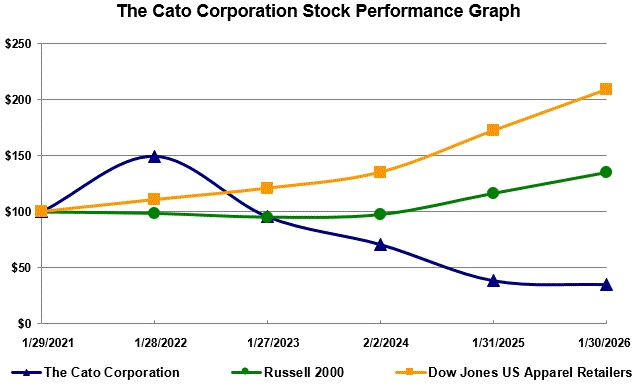
27
Stock Performance Graph
return on the Company’s Common Stock (which includes Class A Stock and Class B Stock) for each of
the Company’s last five fiscal years with (i) the Dow Jones U.S. Retailers, Apparel Index and (ii) the
Russell 2000 Index.
THE CATO CORPORATION
STOCK PERFOMANCE TABLE
(BASE 100 – IN DOLLARS)
LAST TRADING DAY
OF THE FISCAL YEAR
THE CATO
CORPORATION
DOW JONES U.S.
RETAILERS, APPL
INDEX
RUSSELL 2000
INDEX
1/29/2021
100
100
100
1/28/2022
149
111
99
1/27/2023
96
121
95
2/2/2024
71
135
98
1/31/2025
39
173
116
1/30/2026
35
209
135
commencement of the Company’s 2021 fiscal year, and that all dividends were reinvested.
28
Issuer Purchases of Equity Securities
ended January 31, 2026:
Total Number of
Maximum Number
Shares Purchased as
(or Approximate Dollar
Total Number
Value) of Shares that may
Average Price
Announced Plans or
yet be Purchased Under
Period
Purchased
Paid per Share (1)
the Plans or Programs (2)
November 2025
-
$
-
-
December 2025
-
-
-
January 2026
-
-
-
Total
-
$
-
-
680,740
(1)
Prices include trading costs.
(2)
As of November 1, 2025, the Company’s share repurchase program had 680,740 shares remaining in
open authorizations. During the fourth quarter ended January 31, 2026, the Company did not
repurchase or retire any shares under this program. As of the fourth quarter ended January 31, 2026,
the Company had 680,740 shares remaining in open authorizations. There is no specified expiration
date for the Company’s repurchase program.
29
Item 7.
Management's Discussion and Analysis of Financial Condition and Results of Operations:
to provide information to assist readers in better understanding and evaluating our financial condition and
results of operations. The following information should be read in conjunction with the Consolidated
Financial Statements, including the accompanying Notes appearing in Part II, Item 8 of this annual report
on Form 10-K. This section of the annual report on Form 10-K generally discusses fiscal 2025 and fiscal
2024 and year-to-year comparisons between fiscal 2025 and fiscal 2024, as well as certain fiscal 2023
items. Discussions of fiscal 2023 items and year-to-year comparisons between fiscal 2024 and fiscal
2023 that are not included in this Form 10-K can be found in “Management’s Discussion and Analysis of
Financial Condition and Results of Operations” in Part II, Item 7 of the Company’s annual report on
Form 10-K for the fiscal year ended February 1, 2025.
Recent Developments
Tariff Uncertainties and Pressures
subject to reciprocal tariffs throughout fiscal 2025. On February 20, 2026, the Supreme Court struck
down these tariffs. The ruling does not establish a refund process, and significant uncertainty remains
regarding how and when any amounts may be refunded. We are evaluating the ruling and any potential
actions available to us. We are unable to estimate the financial impact, if any, at this time due to
uncertainties regarding the process, timing and amounts of any refunds.
150 days. On March 11 , 2026, the U.S. Trade Representative announced Section 301 investigations into
various countries, including countries where much of our products are manufactured. The extent to which
these Section 301 investigations will result in additional tariffs, and the timing of any potential tariffs, is
currently unknown. Although the tariff amounts are reduced from their levels in the second half of 2025,
the current tariff regime is higher than at the beginning of 2025, which will negatively impact our
acquisition costs in the first half of 2026 and possibly the second half of 2026.
Results of Operations
retail sales for the years indicated:
Fiscal Year Ended
January 31, 2026
February 1, 2025
Retail sales …………………………………………………………..
100.0
%
100.0
%
Other revenue…………………………………………………………
1.1
1.2
Total revenues ……………………………………………………….
101.1
101.2
Cost of goods sold …………………………………………………..
66.7
68.0
Selling, general and administrative………………………………….
35.0
36.1
Depreciation …………………………………………………………
1.5
1.5
Interest and other income ……………………………………………
1.0
1.8
Loss before income taxes …………………………………………
(1.2)
(2.5)
Net loss…………………………………………………………..
(0.9)
%
(2.8)
%
Fiscal 2025 Compared to Fiscal 2024
2024. The increase in retail sales in fiscal 2025 was primarily due to a 4.5% increase in same-store sales,
partially offset by closed stores in 2024 and 2025. Same-store sales for the fiscal year 2025 increased
30
primarily due to higher transactions volume and slightly higher average sales per transaction. Same-store
sales includes stores that have been open more than 15 months. Stores that have been relocated or
expanded are also included in the same-store sales calculation after they have been open more than 15
months. In fiscal 2025 and fiscal 2024, e-commerce sales were less than 5% of total sales and same-store
sales. The method of calculating same-store sales varies across the retail industry. As a result, our same-
store sales calculation may not be comparable to similarly titled measures reported by other companies.
Total revenues, comprised of retail sales and other revenue (principally finance charges and late fees on
customer accounts receivable, gift card breakage, shipping charges for e-commerce purchases and layaway
fees), increased by 0.6% to $653.8 million in fiscal 2025 compared to $649.8 million in fiscal 2024. The
Company operated 1,069 stores at January 31, 2026 compared to 1,117 stores operated at February 1,
2025.
million in fiscal 2024.
dollars and percentage compared to fiscal 2024. Credit revenue is comprised of interest earned on the
Company’s private label credit card portfolio and related fee income. Related expenses include
principally payroll, postage and other administrative expenses and totaled $1.7 million in fiscal 2025
compared to $1.6 million in fiscal 2024. Total credit segment income before taxes was $2.2 million in
fiscal 2025, relatively flat in dollars compared to fiscal 2024.
million, or 68.0% of retail sales, in fiscal 2024. The decrease in cost of goods sold as a percentage of sales
resulted primarily from lower buying, distribution and occupancy costs, partially offset by increased sales of
markdown priced goods. Cost of goods sold includes merchandise costs, net of discounts and allowances,
buying costs, distribution costs, occupancy costs, and freight and inventory shrinkage. Net merchandise
costs and in-bound freight are capitalized as inventory costs. Buying and distribution costs include
payroll, payroll-related costs and operating expenses for the buying departments and distribution center.
Occupancy expenses include rent, real estate taxes, insurance, common area maintenance, utilities and
maintenance for stores and distribution facilities. Total gross margin dollars (retail sales less cost of goods
sold and excluding depreciation) increased by 4.7% to $215.3 million in fiscal 2025 from $205.7 million
in fiscal 2024. Gross margin as presented may not be comparable to that of other companies.
payroll, related payroll taxes and benefits, insurance, supplies, advertising, bank and credit card
processing fees were $226.4 million in fiscal 2025 compared to $231.5 million in fiscal 2024, a decrease
of 2.2%. As a percent of retail sales, SG&A was 35.0% compared to 36.1% in the prior year. The
decrease in SG&A expense in fiscal 2025 was primarily attributable to lower payroll costs and lower
closed store and impairment expenses.
Depreciation expense increased slightly from fiscal 2024 due to additional distribution center and
information technology depreciation, partially offset by a decrease in leasehold improvements and
fixtures depreciation.
2024. The decrease is primarily attributable to gains on the sale of land held for investment and on the
disposal of the Company’s corporate aircraft in 2024.
31
expense of $1.9 million, or 0.3% of retail sales in fiscal 2024. The effective income tax rate was 21.2%
(Benefit) in fiscal 2025 compared to (12.1%) (Expense) in fiscal 2024. The income tax expense decrease
was primarily due to a reduction in foreign income taxes and a larger release of reserves related to expired
statute of limitations for uncertain tax positions in fiscal 2025. On July 4, 2025, the One Big Beautiful
Bill Act (the “OBBBA”) was signed into law. The Company considered the impact of the OBBBA in the
second quarter of fiscal 2025. The changes do not have a material impact on the Company’s effective tax
rate. The Company continues to monitor impacts moving forward. See Note 12 to the Consolidated
Financial Statements, “Income Taxes,” for further details.
Off-Balance Sheet Arrangements
Critical Accounting Policies and Estimates
The Company’s accounting policies are more fully described in Note 1 to the Consolidated Financial
Statements. As disclosed in Note 1 to the Consolidated Financial Statements, the preparation of the
Company’s financial statements in conformity with generally accepted accounting principles in the
United States (“GAAP”) requires management to make estimates and assumptions about future events
that affect the amounts reported in the financial statements and accompanying notes. Future events and
their effects cannot be determined with absolute certainty. Therefore, the determination of estimates
requires the exercise of judgment. Actual results inevitably will differ from those estimates, and such
differences may be material to the financial statements. The most significant accounting estimates
inherent in the preparation of the Company’s financial statements include the calculation of potential asset
impairment, income tax valuation allowances, reserves relating to self-insured health insurance, workers’
compensation, general and auto insurance liabilities, uncertain tax positions, the allowance for customer
credit losses, and inventory shrinkage.
Allowance for Customer Credit Losses
for customer credit losses based on the accounts receivable aging and estimates of actual write-offs. The
allowance is reviewed for adequacy and adjusted, as necessary, on a quarterly basis. The Company also
provides for estimated uncollectible late fees charged based on historical write-offs. The Company’s
financial results can be impacted by changes in customer loss write-off experience and the aging of the
accounts receivable portfolio.
realizable value. Physical inventories are conducted throughout the year to calculate actual shrinkage and
inventory on hand. Actual shrinkage results are used to estimate inventory shrinkage, which is accrued for
the period between the last physical inventory and the financial reporting date. The Company regularly
reviews its inventory levels to identify slow moving merchandise and uses markdowns to clear slow
moving inventory.
The Company determines whether an arrangement is a lease at inception. The Company has operating
leases for stores, offices, warehouse space and equipment. Its leases have remaining lease terms of one
year to 10 years, some of which include options to extend the lease term for up to five years, and some of
32
which include options to terminate the lease within one year. The Company considers these options in
determining the lease term used to establish its right-of-use assets and lease liabilities. The Company’s
lease agreements do not contain any material residual value guarantees or material restrictive covenants.
As most of the Company’s leases do not provide an implicit rate, the Company uses its estimated
incremental borrowing rate based on the information available at commencement date of the lease in
determining the present value of lease payments. See Note 11 to the Consolidated Financial Statements,
“Leases,” for further information.
the opening and remodeling of stores and in computer software and hardware. The Company periodically
reviews its store locations and estimates the recoverability of its long-lived assets, which primarily relate
to Fixtures and equipment, Leasehold improvements, Right-of-use assets net of Lease liabilities and
Information technology equipment and software. An impairment charge is recorded for the amount by
which the carrying value exceeds the estimated fair value when the Company determines that projected
cash flows associated with those long-lived assets will not be sufficient to recover the carrying value. This
determination is based on a number of factors, including the store’s historical operating results and future
projected cash flows, which include contribution margin projections. The Company assesses the fair value
of each lease by considering market rents and any lease terms that may adjust market rents under certain
conditions, such as the loss of an anchor tenant or a leased space in a shopping center not meeting certain
criteria. Further, in determining when to close a store, the Company considers real estate development in
the area and perceived local market conditions, which can be difficult to predict and may be subject to
change.
costs. These costs are significant primarily due to the large number of the Company’s retail locations and
associates. The Company’s self-insurance liabilities are based on the total estimated costs of claims filed
and estimates of claims incurred but not reported, less amounts paid against such claims, and are not
discounted. Management reviews current and historical claims data in developing its estimates. The
Company also uses information provided by outside actuaries with respect to healthcare, workers’
compensation and general liability claims. If the underlying facts and circumstances of the claims change
or the historical experience upon which insurance provisions are recorded is not indicative of future
trends, then the Company may be required to make adjustments to the provision for insurance costs that
could be material to the Company’s reported financial condition and results of operations. Historically,
actual results have not significantly deviated from estimates.
of the balance sheet date. These liabilities reflect the Company’s best estimate of its ultimate income tax
liability based on the tax codes, regulations, and pronouncements of the jurisdictions in which we do
business. Estimating our ultimate tax liability involves significant judgments regarding the application of
complex tax regulations across many jurisdictions. Despite the Company’s belief that the estimates and
judgments are reasonable, differences between the estimated and actual tax liabilities can and do exist
from time to time. These differences may arise from settlements of tax audits, expiration of the statute of
limitations, and the evolution and application of the various jurisdictional tax codes and regulations. Any
differences will be recorded in the period in which they become known and could have a material effect
on the results of operations in the period the adjustment is recorded.
33
Company’s current financial performance and projected future financial performance. Based on this
assessment, the Company then determines if a valuation allowance should be recorded. If the Company
concludes that it is more likely than not that the Company will not be able to realize its tax deferred
assets, a valuation allowance is recorded for the proportion of the deferred tax asset it determines may not
be realized. This evaluation requires significant judgment and involves the consideration of all available
positive and negative evidence, including our historical operating results, the existence of cumulative
losses in recent years, ongoing prudent and feasible tax planning strategies, and projections of future
taxable income.
Liquidity, Capital Resources and Market Risk
flows from operations and its asset-backed revolving line of credit, will be adequate to fund the
Company’s regular operating requirements, including $64.0 million of lease obligations and planned
investments of $7.4 million of capital expenditures, for the next twelve months from the issuance of this
annual report on Form 10-K.
used in fiscal 2024 and $0.5 million provided in fiscal 2023. Cash used in operating activities during 2025
was primarily attributable to net loss adjusted for depreciation, stock-based compensation and changes in
working capital. The decrease of $18.2 million in cash used for fiscal 2025 compared to fiscal 2024 is
primarily due to a lower net loss and a decrease in merchandise inventory, partially offset by a decrease in
accounts payable.
and $55.1 million at February 1, 2025 and February 3, 2024, respectively. The increase in working capital
in fiscal 2025 compared to the prior year is primarily due to lower accounts payable, accrued liabilities and
current lease liability, partially offset by lower cash and cash equivalents and merchandise inventory.
2028 and is secured primarily by inventory and third-party credit card receivables. The proceeds from the
ABL Facility may be used to provide funding for ongoing working capital and general corporate
purposes. There were no borrowings outstanding and the availability under the facility was $30.0 million
before giving effect to a $3.0 million outstanding letter of credit that reduced borrowing availability to
$27.0 million as of January 31, 2026. The weighted average interest rate under the credit facility was
zero at January 31, 2026 due to no outstanding borrowings.
2025, 2024 and 2023, respectively. The decrease in expenditures for fiscal 2025 was primarily due to
finishing projects related to investments in the distribution center and information technology.
provided in fiscal 2024 and $19.8 million provided in fiscal 2023. In fiscal 2025, the decrease in cash
provided was primarily attributable to lower sales of other assets and short-term investments, partially
offset by a decrease in expenditures for property and equipment and purchases of short-term investments.
$14.1 million for fiscal 2024 and $16.1 million for fiscal 2023. The decrease in cash used during fiscal
2025 was primarily due to the elimination of dividend payments and a decrease in share repurchases.
34
regarding the Company’s financial assets that are measured at fair value.
governmental debt securities held in managed accounts with underlying ratings of A or better at January
31, 2026. The corporate bonds have contractual maturities which range from 14 days to 2.6 years. The
U.S. Treasury notes have a contractual maturity of 15 days.
prices may not be available on active exchanges for identical instruments. Their fair value is principally
based on market values determined by management with the assistance of a third-party pricing service. Since
quoted prices in active markets for identical assets are not available, these prices are determined by the
pricing service using observable market information such as quotes from less active markets and/or quoted
prices of securities with similar characteristics, among other factors.
Deferred compensation plan assets consist primarily of life insurance policies. These life insurance
policies are valued based on the cash surrender value of the insurance contract, which is determined based
on such factors as the fair value of the underlying assets and discounted cash flow and are therefore
classified within Level 3 of the valuation hierarchy. The Level 3 liability associated with the life
insurance policies represents a deferred compensation obligation, the value of which is tracked via
underlying insurance funds’ net asset values, as recorded in Other noncurrent liabilities in the
Consolidated Balance Sheets. These funds are designed to mirror the return of existing mutual funds and
money market funds that are observable and actively traded.
Contractual Obligations
commitments for store leases. Operating leases represent minimum required lease payments under non-
cancellable lease terms. Most store leases also require payment of related operating expenses such as
taxes, utilities, insurance and maintenance, which are not included in our estimated lease obligations. See
Note 11 to the Consolidated Financial Statements, “Leases”, for the maturities of our operating lease
obligations.
Recent Accounting Pronouncements
Recently Adopted Accounting Policies” and “—Recently Issued Accounting Pronouncements.”
Item 7A.
Quantitative and Qualitative Disclosures About Market Risk:
financing, investing and cash management activities, but the Company does not believe such exposure is
material.
35
Item 8.
Financial Statements and Supplementary Data:
INDEX TO FINANCIAL STATEMENTS AND SCHEDULE
Page
Report of Independent Registered Public Accounting Firm (PCAOB ID
) .....................................
36
Consolidated Statements of Income (Loss) and Comprehensive Income (Loss) for the fiscal
39
Consolidated Balance Sheets at January 31, 2026 and February 1, 2025 .............................................
40
Consolidated Statements of Cash Flows for the fiscal years ended January 31, 2026, February 1, 2025
41
Consolidated Statements of Stockholders’ Equity for the fiscal years ended January 31, 2026,
42
Notes to Consolidated Financial Statements ..........................................................................................
43
Schedule II — Valuation and Qualifying Accounts for the fiscal years ended January 31, 2026,
76
36
Report of Independent Registered Public Accounting Firm
To the Board of Directors and Stockholders of The Cato Corporation
Opinions on the Financial Statements and Internal Control over Financial Reporting
We have audited the accompanying consolidated balance sheets of The Cato Corporation and its
subsidiaries (the "Company") as of January 31, 2026 and February 1, 2025, and the related consolidated
statements of income (loss) and comprehensive income (loss), of stockholders’ equity and of cash flows
for each of the three years in the period ended January 31, 2026, including the related notes and financial
statement schedule listed in the accompanying index (collectively referred to as the "consolidated
financial statements"). We also have audited the Company's internal control over financial reporting as of
January 31, 2026, based on criteria established in Internal Control - Integrated Framework (2013) issued
by the Committee of Sponsoring Organizations of the Treadway Commission (COSO).
In our opinion, the consolidated financial statements referred to above present fairly, in all material
respects, the financial position of the Company as of January 31, 2026 and February 1, 2025, and the
results of its operations and its cash flows for each of the three years in the period ended January 31, 2026
in conformity with accounting principles generally accepted in the United States of America. Also in our
opinion, the Company maintained, in all material respects, effective internal control over financial
reporting as of January 31, 2026, based on criteria established in Internal Control - Integrated Framework
(2013) issued by the COSO.
Basis for Opinions
The Company's management is responsible for these consolidated financial statements, for maintaining
effective internal control over financial reporting, and for its assessment of the effectiveness of internal
control over financial reporting, included in Management’s Report on Internal Control Over Financial
Reporting appearing under Item 9A. Our responsibility is to express opinions on the Company’s
consolidated financial statements and on the Company's internal control over financial reporting based on
our audits. We are a public accounting firm registered with the Public Company Accounting Oversight
Board (United States) (PCAOB) and are required to be independent with respect to the Company in
accordance with the U.S. federal securities laws and the applicable rules and regulations of the Securities
and Exchange Commission and the PCAOB.
We conducted our audits in accordance with the standards of the PCAOB. Those standards require that
we plan and perform the audits to obtain reasonable assurance about whether the consolidated financial
statements are free of material misstatement, whether due to error or fraud, and whether effective internal
control over financial reporting was maintained in all material respects.
Our audits of the consolidated financial statements included performing procedures to assess the risks of
material misstatement of the consolidated financial statements, whether due to error or fraud, and
performing procedures that respond to those risks. Such procedures included examining, on a test basis,
evidence regarding the amounts and disclosures in the consolidated financial statements. Our audits also
included evaluating the accounting principles used and significant estimates made by management, as
well as evaluating the overall presentation of the consolidated financial statements. Our audit of internal
control over financial reporting included obtaining an understanding of internal control over financial
reporting, assessing the risk that a material weakness exists, and testing and evaluating the design and
operating effectiveness of internal control based on the assessed risk. Our audits also included performing
such other procedures as we considered necessary in the circumstances. We believe that our audits
provide a reasonable basis for our opinions.
37
Definition and Limitations of Internal Control over Financial Reporting
A company’s internal control over financial reporting is a process designed to provide reasonable
assurance regarding the reliability of financial reporting and the preparation of financial statements for
external purposes in accordance with generally accepted accounting principles. A company’s internal
control over financial reporting includes those policies and procedures that (i) pertain to the maintenance
of records that, in reasonable detail, accurately and fairly reflect the transactions and dispositions of the
assets of the company; (ii) provide reasonable assurance that transactions are recorded as necessary to
permit preparation of financial statements in accordance with generally accepted accounting principles,
and that receipts and expenditures of the company are being made only in accordance with authorizations
of management and directors of the company; and (iii) provide reasonable assurance regarding prevention
or timely detection of unauthorized acquisition, use, or disposition of the company’s assets that could
have a material effect on the financial statements.
Because of its inherent limitations, internal control over financial reporting may not prevent or detect
misstatements. Also, projections of any evaluation of effectiveness to future periods are subject to the risk
that controls may become inadequate because of changes in conditions, or that the degree of compliance
with the policies or procedures may deteriorate.
Critical Audit Matters
The critical audit matter communicated below is a matter arising from the current period audit of the
consolidated financial statements that was communicated or required to be communicated to the audit
committee and that (i) relates to accounts or disclosures that are material to the consolidated financial
statements and (ii) involved our especially challenging, subjective, or complex judgments. The
communication of critical audit matters does not alter in any way our opinion on the consolidated
financial statements, taken as a whole, and we are not, by communicating the critical audit matter below,
providing a separate opinion on the critical audit matter or on the accounts or disclosures to which it
relates.
Impairment of Long-Lived Assets - Store Location Asset Groupings
As described in Notes 1 and 6 to the consolidated financial statements, the Company’s consolidated
property and equipment, net balance was $53.7 million, of which the store locations were a portion, and
consolidated operating lease right-of-use assets, net balance was $153.9 million as of January 31, 2026.
The Company invests in leaseholds, right-of-use assets and equipment, primarily in connection with the
opening and remodeling of stores, and in computer software and hardware. The Company periodically
reviews its store locations and estimates the recoverability of its long-lived assets, which primarily relate
to fixtures and equipment, leasehold improvements, right-of-use assets net of lease liabilities, and
information technology equipment and software. An impairment charge is recorded for the amount by
which the carrying value exceeds the estimated fair value when management determines that projected
cash flows associated with those long-lived assets will not be sufficient to recover the carrying value. This
determination is based on a number of factors, including the store’s historical operating results and future
projected cash flows, which include contribution margin projections. The Company assesses the fair value
of each lease by considering market rents and any lease terms that may adjust market rents under certain
conditions such as the loss of an anchor tenant or a leased space in a shopping center not meeting certain
criteria. An impairment charge for store assets of $0.2 million was recorded during the year ended
January 31, 2026.
The principal considerations for our determination that performing procedures relating to impairment of
long-lived assets – store location asset groupings is a critical audit matter are (i) the significant judgment
by management when determining the fair value measurement of the store location asset groupings,
which led to (ii) a high degree of auditor judgment, subjectivity, and effort in performing procedures and
evaluating management’s projected cash flow assumptions related to contribution margin projections.
38
Addressing the matter involved performing procedures and evaluating audit evidence in connection with
forming our overall opinion on the consolidated financial statements. These procedures included testing
the effectiveness of controls relating to management’s long-lived assets – store location recoverability test
and determination of the fair value of the asset groupings. These procedures also included, among others,
(i) testing the completeness and accuracy of underlying data used in the projected cash flows and store
location asset groupings, (ii) evaluating the reasonableness of management’s assumptions related to
contribution margin projections by considering current and historical performance of the store location
asset groupings and whether the assumptions were consistent with evidence obtained in other areas of the
audit, (iii) evaluating the appropriateness of the projected cash flow model, and (iv) evaluating
management’s assessment of the fair value of the leased assets included in the store location asset
groupings.
/s/
March 25, 2026
We have served as the Company’s auditor since 2003.
39
THE CATO CORPORATION
CONSOLIDATED STATEMENTS OF INCOME (LOSS) AND
COMPREHENSIVE INCOME (LOSS)
Fiscal Year Ended
January 31, 2026
February 1, 2025
February 3, 2024
(Dollars in thousands, except per share data)
REVENUES
$
$
$
COSTS AND EXPENSES, NET
(6,687 )
(11,827 )
(5,101 )
Loss before income taxes
(7,500 )
(16,113 )
(13,801 )
Income tax (benefit) expense
(1,591 )
Net loss
$
(5,909 )
$
(18,057 )
$
(23,941 )
Basic earnings (loss) per share
$
(0.31 )
$
(0.97 )
$
(1.17 )
Diluted earnings (loss) per share
$
(0.31 )
$
(0.97 )
$
(1.17 )
Dividends per share
$
$
$
Comprehensive income (loss):
Net loss
$
(5,909 )
$
(18,057 )
$
(23,941 )
Net unrealized gain (loss) on available-for-sale
(242 )
Comprehensive loss
$
(5,788 )
$
(18,299 )
$
(22,308 )
See notes to consolidated financial statements.
40
THE CATO CORPORATION
CONSOLIDATED BALANCE SHEETS
January 31, 2026
February 1, 2025
(Dollars in thousands, except share and per share data)
ASSETS
Current Assets:
Cash and cash equivalents
$
$
Short-term investments
Restricted cash
Accounts receivable, net of allowance for customer credit losses of $
Merchandise inventories
Prepaid expenses and other current assets
Property and equipment – net
Other assets
Right-of-Use assets - net
$
$
LIABILITIES AND STOCKHOLDERS' EQUITY
Current Liabilities:
Accounts payable
$
$
Accrued expenses
Accrued bonus and benefits
Current lease liability
Other noncurrent liabilities
Lease liability
Commitments and contingencies
-
-
Stockholders' Equity:
Preferred stock, $
Class A common stock, $
Convertible Class B common stock, $
Additional paid-in capital
Retained earnings
Accumulated other comprehensive income
$
$
See notes to consolidated financial statements.
41
THE CATO CORPORATION
CONSOLIDATED STATEMENTS OF CASH FLOWS
Fiscal Year Ended
January 31, 2026
February 1, 2025
February 3, 2024
(Dollars in thousands)
Operating Activities:
Net loss
$
(5,909 )
$
(18,057 )
$
(23,941 )
Adjustments to reconcile net loss to net cash (used in) provided
(908 )
(1,131 )
(711 )
(37 )
(5,343 )
(668 )
(1,412 )
(608 )
(12,136 )
(1,237 )
(212 )
(216 )
(511 )
(1,410 )
(2,056 )
(613 )
(30,538 )
(10,053 )
Net cash (used in) provided by operating activities
(1,461 )
(19,745 )
Investing Activities:
Expenditures for property and equipment
(3,763 )
(7,872 )
(12,532 )
Purchase of short-term investments
(25,446 )
(39,612 )
(48,055 )
Sales of short-term investments
Sales of other assets
(8 )
Net cash (used in) provided by investing activities
(1,303 )
Financing Activities:
Dividends paid
(10,516 )
(13,954 )
Repurchase of common stock
(995 )
(3,877 )
(2,562 )
Proceeds from employee stock purchase plan
Net cash used in financing activities
(851 )
(14,055 )
(16,132 )
Net (decrease) increase in cash, cash equivalents, and restricted cash
(3,615 )
(4,835 )
Cash, cash equivalents, and restricted cash at beginning of period
Cash, cash equivalents, and restricted cash at end of period
$
$
$
Non-cash activity:
Accrued property and equipment expenditures
$
$
$
Accrued treasury stock
Life insurance receivable
See notes to consolidated financial statements.
42
THE CATO CORPORATION
CONSOLIDATED STATEMENTS OF STOCKHOLDERS' EQUITY
Accumulated
Additional
Other
Total
Common
Paid-In
Retained
Comprehensive
Stockholders'
Stock
Capital
Earnings
Income
Equity
(Dollars in thousands, except per share data)
Balance — January 28, 2023
$
$
$
$
(1,238 )
$
Comprehensive income:
(23,941 )
(23,941 )
Dividends paid ($
(13,954 )
(13,954 )
Class A common stock sold through employee stock purchase plan
Share-based compensation expense
Repurchase and retirement of treasury shares
(9 )
(2,553 )
(2,562 )
Balance — February 3, 2024
$
$
$
$
$
Comprehensive income:
(18,057 )
(18,057 )
(242 )
(242 )
Dividends paid ($
(10,516 )
(10,516 )
Class A common stock sold through employee stock purchase plan
Share-based compensation expense
Repurchase and retirement of treasury shares
(30 )
(3,847 )
(3,877 )
Balance — February 1, 2025
$
$
$
$
$
Comprehensive income:
(5,909 )
(5,909 )
Class A common stock sold through employee stock purchase plan
Share-based compensation expense
(2 )
Repurchase and retirement of treasury shares
(11 )
(984 )
(995 )
Other
(16 )
(16 )
Balance — January 31, 2026
$
$
$
$
$
See notes to consolidated financial statements.
THE CATO CORPORATION
NOTES TO CONSOLIDATED FINANCIAL STATEMENTS
43
1. Summary of Significant Accounting Policies:
Principles of Consolidation:
The Consolidated Financial Statements include the accounts of The Cato
Corporation and its wholly-owned subsidiaries (the “Company”). All significant intercompany accounts
and transactions have been eliminated.
Description of Business and Fiscal
Year:
operation of a fashion specialty stores segment (“Retail Segment”) and a credit card segment (“Credit
Segment”). The fashion specialty stores operate under the names “Cato,” “Cato Fashions,” “Cato Plus,”
“It’s Fashion,” “It’s Fashion Metro,” “Versona ” and “Cache,” including e-commerce websites. The stores
are located primarily in strip shopping centers principally in the southeastern United States. The
Company’s fiscal year ends on the Saturday nearest January 31 of the subsequent year. Fiscal year 2025
and 2024 are
-week years and 2023 is a
-week year.
Use of Estimates:
accounting principles generally accepted in the United States (“GAAP”) requires management to make
estimates and assumptions that affect the reported amounts of assets and liabilities and disclosure of
contingent assets and liabilities at the date of the financial statements and the reported amounts of
revenues and expenses during the reporting period. Actual results could differ from those estimates.
Significant accounting estimates reflected in the Company’s financial statements include the calculation
of potential asset impairment, income tax valuation allowances, reserves relating to self-insured health
insurance, workers’ compensation, general and auto insurance liabilities, uncertain tax positions, the
allowance for customer credit losses, and inventory shrinkage.
Cash and Cash Equivalents:
Cash and cash equivalents consist of highly liquid investments with
original maturities of three months or less.
Short-Term Investments:
as short-term investments. See Note 3 for the Company’s estimated fair value of, and other information
regarding, its short-term investments.
The Company’s short-term investments are all classified as
available-for-sale. As they are available for current operations, they are classified on the Consolidated
Balance Sheets as Current Assets. Available-for-sale securities are carried at fair value, with unrealized
gains and temporary losses, net of income taxes, reported as a component of Accumulated other
comprehensive income. Other than temporary declines in the fair value of investments are recorded as a
reduction in the cost of the investments in the accompanying Consolidated Balance Sheets and a
reduction of Interest and other income in the accompanying Consolidated Statements of Income (Loss)
and Comprehensive Income (Loss). The cost of debt securities is adjusted for amortization of premiums
and accretion of discounts to maturity. The amortization of premiums, accretion of discounts and realized
gains and losses are included in Interest and other income.
Restricted Cash:
The Company had $
February 1, 2025, respectively, as security and collateral for administration of the Company’s self-insured
workers’ compensation and general liability coverage, which is reported as Restricted cash on the
Consolidated Balance Sheets.
Supplemental Cash Flow Information:
Income tax payments, net of refunds received, for the fiscal
years ended January 31, 2026, February 1, 2025, and February 3, 2024 are detailed in the table below:
THE CATO CORPORATION
NOTES TO CONSOLIDATED FINANCIAL STATEMENTS
44
`
Fiscal Year Ended
January 31, 2026
February 1, 2025
February 3, 2024
(Dollars in thousands)
Federal taxes
$
(314 )
$
(860 )
$
(1 )
State taxes
(174 )
Foreign taxes
Total income taxes paid
$
$
$
Inventories:
Merchandise inventories are stated at the net realizable value as determined by the
weighted-average cost method.
Property and Equipment:
Property and equipment are recorded at cost, including land. Maintenance
and repairs are expensed to operations as incurred; renewals and betterments are capitalized. Depreciation
is determined on the straight-line method over the estimated useful lives of the related assets excluding
leasehold improvements. Leasehold improvements are amortized over the shorter of the estimated useful
life or lease term. For leases with renewal periods at the Company’s option, the Company generally uses
the original lease term plus reasonably assured renewal option periods (generally one five-year option
period) to determine estimated useful lives. Typical estimated useful lives are as follows:
`
Estimated
Classification
Useful Lives
Land improvements
Buildings
-
Leasehold improvements
-
Fixtures and equipment
-
Information technology equipment and software
-
Impairment of Long-Lived Assets:
equipment primarily in connection with the opening and remodeling of stores and in computer software
and hardware. The Company periodically reviews its store locations and estimates the recoverability of its
long-lived assets, which primarily relate to Fixtures and equipment, Leasehold improvements, Right-of-
use assets net of Lease liabilities and Information technology equipment and software. An impairment
charge is recorded for the amount by which the carrying value exceeds the estimated fair value when the
Company determines that undiscounted projected cash flows associated with those long-lived assets will
not be sufficient to recover the carrying value. This determination is based on a number of factors,
including each store’s historical operating results and future projected cash flows, which include
contribution margin projections. The Company assesses the fair value of each lease by considering market
rents and any lease terms that may adjust market rents under certain conditions, such as the loss of an
anchor tenant or a leased space in a shopping center not meeting certain criteria. Further, in determining
when to close a store, the Company considers real estate development in the area and perceived local
market conditions, which can be difficult to predict and may be subject to change. Asset impairment
charges of $
, $
respectively.
Other Assets:
Other assets are comprised of long-term assets, primarily insurance contracts related to
deferred compensation assets and land held for investment purposes.
THE CATO CORPORATION
NOTES TO CONSOLIDATED FINANCIAL STATEMENTS — (Continued)
45
`
Balance as of
January 31, 2026
February 1, 2025
(Dollars in thousands)
Other Assets
$
$
Total Other Assets
$
$
Leases:
The Company leases all of its retail stores. Most lease agreements contain construction
allowances and rent escalations. For purposes of recognizing incentives and minimum rental expenses on
a straight-line basis over the terms of the leases, including renewal periods considered reasonably assured,
the Company begins amortization as of the initial possession date, which is when the Company enters the
space and begins to make improvements in preparation for intended use.
Revenue Recognition:
The Company recognizes sales at the point of purchase when the customer
takes possession of the merchandise and pays for the purchase, generally with cash or credit. Sales from
purchases made with Cato credit, gift cards and layaway sales from stores are also recorded when the
customer takes possession of the merchandise. E-commerce sales are recorded when the risk of loss is
transferred to the customer. Gift cards are recorded as deferred revenue until they are redeemed or
forfeited. Gift cards do not have expiration dates. Layaway sales are recorded as deferred revenue until
the customer takes possession or forfeits the merchandise. A provision is made for estimated merchandise
returns based on sales volumes and the Company’s experience; actual returns have not varied materially
from historical amounts. A provision is made for estimated write-offs associated with sales made with the
Company’s proprietary credit card. In addition, a provision is made for estimated rewards cards issued to
customers based on their purchases with the Company’s propriety credit card. The rewards cards issued
by the Company have a
-day expiration. Amounts related to shipping and handling billed to customers
in a sales transaction are classified as Other revenue and the costs related to shipping product to
customers (billed and accrued) are classified as Cost of goods sold.
Revenue from Contracts with Customers (Topic 606)
in fiscal 2025, 2024 and 2023, the Company recognized $
, $
,
respectively, of income on unredeemed gift cards (“gift card breakage”) as a component of Other
Revenue on the Consolidated Statements of Income (Loss) and Comprehensive Income (Loss). Under
Topic 606, the Company recognizes gift card breakage using an expected breakage percentage based on
historical redeemed gift cards. See Note 2 for further information on miscellaneous income.
the Company’s wholly-owned subsidiaries. None of the credit card receivables are secured. The
Company estimated customer credit losses of $
January 31, 2026 and February 1, 2025, respectively, on sales purchased using the Company’s proprietary
credit card of $
February 1, 2025, respectively.
customers (in thousands):
THE CATO CORPORATION
NOTES TO CONSOLIDATED FINANCIAL STATEMENTS — (Continued)
46
`
Balance as of
January 31, 2026
February 1, 2025
Proprietary Credit Card Receivables, net
$
$
Gift Card Liability
$
$
Cost of Goods Sold:
Cost of goods sold includes merchandise costs, net of discounts and allowances,
buying costs, distribution costs, occupancy costs, freight, and inventory shrinkage. Net merchandise costs
and in-bound freight are capitalized as inventory costs. Buying and distribution costs include payroll,
payroll-related costs and operating expenses for the Company’s buying departments and distribution
center. Occupancy expenses include rent, real estate taxes, insurance, common area maintenance, utilities
and maintenance for stores and distribution facilities. Buying, distribution, occupancy and internal
transfer costs are treated as period costs and are not capitalized as part of inventory. The direct costs
associated with shipping goods to customers are recorded as a component of Cost of goods sold.
Advertising:
Advertising costs are expensed in the period in which they are incurred. Advertising
expense was approximately $
, $
2026, February 1, 2025 and February 3, 2024, respectively.
Stock Repurchase Program:
For the fiscal year ended January 31, 2026, the Company had
shares remaining in open authorizations. There is no specified expiration date for the Company’s
repurchase program. Share repurchases are recorded in Retained earnings, net of par value.
Earnings (Loss) Per Share:
ASC 260 –
Earnings Per Share
and diluted EPS on the face of all income statements for all entities with complex capital structures. The
Company has presented one basic EPS and one diluted EPS amount for all common shares in the
accompanying Consolidated Statements of Income (Loss) and Comprehensive Income (Loss). While the
Company’s certificate of incorporation provides the right for the Board of Directors to declare dividends
on Class A shares without declaration of commensurate dividends on Class B shares, the Company has
historically paid the same dividends to both Class A and Class B shareholders and the Board of Directors
has resolved to continue this practice. Accordingly, the Company’s allocation of income for purposes of
EPS computation is the same for Class A and Class B shares and the EPS amounts reported herein are
applicable to both Class A and Class B shares.
divided by the weighted average number of common shares outstanding for the period. Diluted EPS
reflects the potential dilution that could occur from common shares issuable through stock options and the
Employee Stock Purchase Plan.
31, 2026, February 1, 2025 and February 3, 2024:
THE CATO CORPORATION
NOTES TO CONSOLIDATED FINANCIAL STATEMENTS — (Continued)
47
`
Fiscal Year Ended
January 31, 2026
February 1, 2025
February 3, 2024
Numerator
(Dollars in thousands)
Net earnings (loss)
$
(5,909 )
$
(18,057 )
$
(23,941 )
(Earnings) loss allocated to non-vested equity awards
(548 )
Net earnings (loss) available to common stockholders
$
(5,909 )
$
(18,605 )
$
(22,594 )
Denominator
Basic weighted average common shares outstanding
Diluted weighted average common shares outstanding
Net income (loss) per common share
Basic earnings (loss) per share
$
(0.31 )
$
(0.97 )
$
(1.17 )
Diluted earnings (loss) per share
$
(0.31 )
$
(0.97 )
$
(1.17 )
Unvested restricted stock excluded from the calculation of diluted EPS for the fiscal years ended
January 31, 2026, February 1, 2025, and February 3, 2024 were
,
, and
,
respectively, because the effect of including them in the calculation of diluted EPS would have been
antidilutive.
Ve
ndor Allowances:
The Company receives certain allowances from
vendors primarily related to
purchase discounts and markdown and damage allowances. All allowances are reflected in Cost of goods
sold as earned when the related products are sold. Cash consideration received from a vendor is
presumed to be a reduction of the purchase cost of merchandise and is reflected as a reduction of
inventory. The Company does not receive cooperative advertising allowances.
Income Taxes:
The Company files a consolidated federal income tax return. Income taxes are
provided based on the asset and liability method of accounting, whereby deferred income taxes are
provided for temporary differences between the financial reporting basis and the tax basis of the
Company’s assets and liabilities.
Income Taxes
Company believes these positions may be challenged and the results are uncertain. The Company adjusts
these liabilities in light of changing facts and circumstances. Potential accrued interest and penalties
related to unrecognized tax benefits within operations are recognized as a component of Income before
income taxes.
(“GILTI”). The Company has elected to account for GILTI tax in the period in which it is incurred, which
is included as a component of its current year provision for income taxes.
Deferred Tax Valuation Allowance:
The Company assesses the likelihood that deferred tax assets
will be realized in light of the Company’s current financial performance and projected future financial
performance. Based on this assessment, the Company then determines if a valuation allowance should be
recorded. If the Company concludes that it is more likely than not that the Company will not be able to
realize its tax deferred assets, a valuation allowance is recorded for the proportion of the deferred tax asset
it determines may not be realized.
Store Opening Costs:
Costs relating to the opening of new stores or the relocating or
expanding of existing stores are expensed as incurred. A portion of construction, design, and site
selection costs are capitalized to new, relocated and remodeled stores.
THE CATO CORPORATION
NOTES TO CONSOLIDATED FINANCIAL STATEMENTS — (Continued)
48
Insurance:
The Company is self-insured with respect to employee health care, workers’ compensation
and general liability. The Company’s self-insurance liabilities are based on the total estimated cost of
claims filed and estimates of claims incurred but not reported, less amounts paid against such claims, and
are not discounted. Management reviews current and historical claims data in developing its estimates.
The Company has stop-loss insurance coverage for individual claims in excess of $
healthcare, $
Fair Value of Financial Instruments:
as cash and cash equivalents, short-term investments, and restricted cash, approximate their fair values
due to their short terms to maturity and/or their variable interest rates.
Stock Based Compensation:
stock and other forms of equity compensation in accordance with ASC 718 -
Compensation – Stock
Compensation.
includes: 1) amortization related to the remaining unvested portion of all stock awards based on the grant
date fair value and 2) adjustments for the effects of actual forfeitures versus initial estimated forfeitures.
Recently Adopted Accounting Pronouncements:
09, “Income Taxes (Topic 740): Improvements to Income Tax Disclosures,” which modifies the
requirements on income tax disclosures to require disaggregated information about a reporting entity’s
effective tax rate reconciliation, as well as information on income taxes paid. The Company adopted the
standard on a retrospective basis effective for its annual period ended January 31, 2026. See Note 12,
“Income Taxes.”
Recently Issued Accounting Pronouncements:
“Income Statement – Reporting Comprehensive Income – Expense Disaggregation Disclosures (Subtopic
220-40): Disaggregation of Income Statement Expenses,” which requires public entities to disclose, on an
annual and interim basis, disaggregated information in the footnotes about specified information related to
certain costs and expenses. This guidance is effective for annual periods beginning after December 15,
2026, and interim periods beginning after December 15, 2027, with early adoption permitted. The
Company is currently in the process of evaluating the potential impact of adoption of this new guidance
on its consolidated financial statements and related disclosures.
will have a material impact on the Company’s financial statements.
2. Interest and Other Income:
The components of Interest and other income are shown below (in thousands):
Fiscal Year Ended
January 31, 2026
February 1, 2025
February 3, 2024
Dividend income
$
(57 )
$
(75 )
$
(78 )
Interest income
(4,002 )
(5,019 )
(3,919 )
Miscellaneous income
(1,779 )
(1,389 )
(1,079 )
Net gain on investment sales
(849 )
(5,344 )
(25 )
Interest and other income
$
(6,687 )
$
(11,827 )
$
(5,101 )
During fiscal 2024, the Company received $
of its corporate jet, which had sustained damage in fiscal 2023. The Company recorded a net gain of $
million which is included in Interest and other income in the accompanying Consolidated Statements of
Income (Loss) and Comprehensive Income (Loss) for the year ended February 1, 2025.
THE CATO CORPORATION
NOTES TO CONSOLIDATED FINANCIAL STATEMENTS — (Continued)
49
3. Short-Term Investments:
governmental debt securities held in managed accounts. These securities are classified as available-for-
sale as they are highly liquid and are recorded on the Consolidated Balance Sheets at estimated fair value,
with unrealized gains and temporary losses reported net of taxes in Accumulated other comprehensive
income.
January 31, 2026 and February 1, 2025 (in thousands):
`
January 31, 2026
February 1, 2025
Debt securities
Debt securities
issued by the U.S.
issued by the U.S.
Government, its various
Government, its various
States, municipalities
Corporate
States, municipalities
Corporate
and agencies
debt
and agencies
debt
of each
securities
Total
of each
securities
Total
Cost basis
$
$
$
$
$
$
Unrealized gains
Unrealized (loss)
(10 )
(10 )
Estimated fair value
$
$
$
$
$
$
Accumulated other comprehensive income on the Consolidated Balance Sheets reflects the
accumulated unrealized gains and losses in short-term investments in addition to unrealized gains and
losses from equity investments and restricted cash investments. The table below reflects gross
accumulated unrealized gains and losses in these investments at January 31, 2026 and February 1, 2025
(in thousands):
`
January 31, 2026
February 1, 2025
Deferred
Unrealized
Deferred
Unrealized
Unrealized
Tax Benefit/
Net Gain/
Unrealized
Tax Benefit/
Net Gain/
Security Type
Gain/(Loss)
(Expense)
(Loss)
Gain/(Loss)
(Expense)
(Loss)
Short-Term Investments
$
$
$
$
$
$
Total
$
$
$
$
$
$
THE CATO CORPORATION
NOTES TO CONSOLIDATED FINANCIAL STATEMENTS — (Continued)
50
4. Fair Value Measurements:
at fair value as of January 31, 2026 and February 1, 2025 (in thousands):
`
Prices in
Active
Significant
Markets for
Other
Significant
Identical
Observable
Unobservable
January 31, 2026
Assets
Inputs
Inputs
Description
Level 1
Level 2
Level 3
Assets:
$
$
$
$
Total Assets
$
$
$
$
Liabilities:
$
(8,383 )
$
$
$
(8,383 )
Total Liabilities
$
(8,383 )
$
$
$
(8,383 )
Prices in
Active
Significant
Markets for
Other
Significant
Identical
Observable
Unobservable
February 1, 2025
Assets
Inputs
Inputs
Description
Level 1
Level 2
Level 3
Assets:
$
$
$
$
Total Assets
$
$
$
$
Liabilities:
$
(8,548 )
$
$
$
(8,548 )
Total Liabilities
$
(8,548 )
$
$
$
(8,548 )
The Company’s investment portfolio at January 31, 2026 was primarily invested in corporate bonds
and taxable governmental debt securities held in managed accounts with underlying ratings of A or better.
The corporate bonds have contractual maturities which range from
2.6 years
. The U.S.
Treasury notes have a contractual maturity of
.
not be available on active exchanges for identical instruments. Their fair value is principally based on market
values determined by management with the assistance of a third-party pricing service. Since quoted prices in
active markets for identical assets are not available, these prices are determined by the pricing service using
observable market information such as quotes from less active markets and/or quoted prices of securities with
similar characteristics, among other factors.
policies are valued based on the cash surrender value of the insurance contract, which is determined based
on such factors as the fair value of the underlying assets and discounted cash flow and are therefore
classified within Level 3 of the valuation hierarchy. The Level 3 liability associated with the life
insurance policies represents a deferred compensation obligation, the value of which is tracked via
THE CATO CORPORATION
NOTES TO CONSOLIDATED FINANCIAL STATEMENTS — (Continued)
51
underlying insurance funds’ net asset values, as recorded in Other noncurrent liabilities in the
Consolidated Balance Sheets. These funds are designed to mirror the return of existing mutual funds and
money market funds that are observable and actively traded.
THE CATO CORPORATION
NOTES TO CONSOLIDATED FINANCIAL STATEMENTS — (Continued)
52
The following tables summarize the change in fair value of the Company’s financial assets and liabilities
measured using Level 3 inputs for the years ended January 31, 2026 and
February 1, 2025
`
Fair Value
Measurements Using
Significant Unobservable
Asset Inputs (Level 3)
Cash
Surrender Value
Beginning Balance at February 1, 2025
$
(365 )
Ending Balance at January 31, 2026
$
Fair Value
Measurements Using
Significant Unobservable
Liability Inputs (Level 3)
Deferred
Compensation
Beginning Balance at February 1, 2025
$
(8,548 )
(206 )
(875 )
Ending Balance at January 31, 2026
$
(8,383 )
Fair Value
Measurements Using
Significant Unobservable
Asset Inputs (Level 3)
Cash
Surrender Value
Beginning Balance at February 3, 2024
$
Ending Balance at February 1, 2025
$
Fair Value
Measurements Using
Significant Unobservable
Liability Inputs (Level 3)
Deferred
Compensation
Beginning Balance at February 3, 2024
$
(8,654 )
(220 )
(849 )
Ending Balance at February 1, 2025
$
(8,548 )
THE CATO CORPORATION
NOTES TO CONSOLIDATED FINANCIAL STATEMENTS — (Continued)
53
5.
Accounts Receivable:
Accounts receivable consist of the following (in thousands):
January 31, 2026
February 1, 2025
Customer accounts — principally deferred payment accounts
$
$
Income tax receivable
Miscellaneous receivables
Bank card receivables
Total
Less allowance for customer credit losses
Accounts receivable — net
$
$
Finance charge and late charge revenue on customer deferred payment accounts totaled $
,
$
years ended January 31, 2026, February 1, 2025 and February 3,
2024, respectively, and charges against the allowance for customer credit losses were approximately
$
, $
February 3, 2024, respectively. Expenses relating to the allowance for customer credit losses are
classified as a component of Selling, general and administrative expense in the accompanying
Consolidated Statements of Income (Loss) and Comprehensive Income (Loss).
6.
Property and Equipment:
Property and equipment consist of the following (in thousands):
January 31, 2026
February 1, 2025
Land and improvements
$
$
Buildings
Leasehold improvements
Fixtures and equipment
Information technology equipment and software
Construction in progress
Total
Less accumulated depreciation
Property and equipment — net
$
$
distribution center improvements and investments in new technology.
7.
Accrued Expenses:
Accrued expenses consist of the following (in thousands):
January 31, 2026
February 1, 2025
Accrued employment and related items
$
$
Property and other taxes
Accrued self-insurance
Other
Total
$
$
THE CATO CORPORATION
NOTES TO CONSOLIDATED FINANCIAL STATEMENTS — (Continued)
54
8. Financing Arrangements:
On March 13, 2025, the Company, as borrower, and certain other domestic subsidiaries, as borrowers
and guarantors, entered into a Credit Agreement (the “ABL Credit Agreement”) and related loan
documents, by and among the Company, certain other of the Company’s domestic subsidiaries, and Wells
Fargo Bank, National Association, as the lender (the “Lender”), to establish an asset-based revolving
credit facility (the “ABL Facility”) in an amount up to $
may be used to provide funding for ongoing working capital and general corporate purposes.
March 2028
and third-party credit card receivables. There were
the facility was $
reduced borrowing availability to $
rate under the credit facility was
9. Stockholders’ Equity:
, whereas the holders of
Class B Common Stock are entitled to
. Each share of Class B Common Stock may be
converted at any time into one share of Class A Common Stock. Subject to the rights of the holders of any
shares of Preferred Stock that may be outstanding at the time, in the event of liquidation, dissolution or
winding up of the Company, holders of Class A Common Stock are entitled to receive a preferential
distribution of $
Stock cannot be paid unless cash dividends of at least an equal amount are paid on the Class A Common
Stock.
transferred only to certain “Permitted Transferees” consisting generally of the lineal descendants of
holders of Class B Common Stock, trusts for their benefit, corporations and partnerships controlled by
them and the Company’s employee benefit plans. Any transfer of Class B Common Stock in violation of
these restrictions, including a transfer to the Company, results in the automatic conversion of the
transferred shares of Class B Common Stock held by the transferee into an equal number of shares of
Class A Common Stock.
February 1, 2025, and February 3, 2024 are presented below (in thousands):
Convertible
Class A
Class B
Common Stock
Common Stock
January 28, 2023
Repurchases
(288 )
Share-based compensation
February 3, 2024
Repurchases
(912 )
Share-based compensation
February 1, 2025
Repurchases
(317 )
Share-based compensation
(20 )
January 31, 2026
THE CATO CORPORATION
NOTES TO CONSOLIDATED FINANCIAL STATEMENTS — (Continued)
55
10. Employee Benefit Plans:
associates who meet minimum age and service requirements.
administrative expenses. Further Company contributions are at the discretion of the Board of Directors.
The Company contributed $
for the years ended February 1, 2025 and February 3, 2024 were approximately $
,
respectively.
Company’s discretionary contribution to the ESOP is determined by the Compensation Committee of the
Board of Directors and can be made in Company Class A Common stock or cash. Due to net operating
losses in fiscal 2025, fiscal 2024, and fiscal 2023, the Committee did not approve a contribution to the
ESOP for the years ended January 31, 2026, February 1, 2025, and February 3, 2024.
large number of the Company’s retail locations and associates. The Company’s self-insurance liabilities
are based on the total estimated costs of claims filed and estimates of claims incurred but not reported,
less amounts paid against such claims. Management reviews current and historical claims data in
developing its estimates. If the underlying facts and circumstances of the claims change or the historical
trend is not indicative of future trends, then the Company may be required to record additional expense or
a reduction to expense which could be material to the Company’s reported results of operations in the
period recorded. The Company funds healthcare contributions to a third-party provider.
11.
Leases:
The Company determines whether an arrangement is a lease at inception. The Company has operating
leases for stores, offices, warehouse space and equipment. Its leases have remaining lease terms of
, some of which include options to extend the lease term for
, and some of
which include options to terminate the lease
. The Company considers these options in
determining the lease term used to establish its right-of-use assets and lease liabilities. The Company’s
lease agreements do not contain any material residual value guarantees or material restrictive covenants.
incremental borrowing rate based on the information available at commencement date of the lease in
determining the present value of lease payments.
THE CATO CORPORATION
NOTES TO CONSOLIDATED FINANCIAL STATEMENTS — (Continued)
56
`
Fiscal Year Ended
January 31, 2026
February 1, 2025
February 3, 2024
Operating lease cost (a)
$
$
$
Variable lease cost (b)
$
$
$
(a) Includes right-of-use asset amortization of ($
) million, ($
) million, and ($
) million for the twelve months ended
January 31, 2026, February 1, 2025, and February 3, 2024 respectively.
(b) Primarily relates to monthly percentage rent for stores not presented on the balance sheet.
Supplemental cash flow information and non-cash activity related to the Company’s operating leases
are as follows (in thousands):
Operating cash flow information:
Fiscal Year Ended
January 31, 2026
February 1, 2025
February 3, 2024
Cash paid for amounts included in the measurement of
lease liabilities
$
$
$
Non-cash activity:
Right-of-use assets obtained in exchange for lease
obligations, net of rent violations
$
$
$
THE CATO CORPORATION
NOTES TO CONSOLIDATED FINANCIAL STATEMENTS — (Continued)
57
Weighted-average remaining lease term and discount rate for the Company’s operating leases are as
follows:
`
As of
January 31, 2026
February 1, 2025
Weighted-average remaining lease term
Weighted-average discount rate
Maturities of lease liabilities by fiscal year for the Company’s operating leases are as follows (in
thousands):
Fiscal Year
2026
$
2027
2028
2029
2030
Thereafter
Total lease payments
Less: Imputed interest
Present value of lease liabilities
$
12. Income Taxes:
liabilities, are established in accordance with ASC 740 when, despite the fact that the tax return positions
are supportable, the Company believes these positions may be challenged and the results are uncertain.
The Company adjusts these liabilities in light of changing facts and circumstances. As of January 31,
2026, the Company had gross unrecognized tax benefits totaling approximately $
the gross unrecognized tax benefits, and interest and penalties, $
rate if recognized. The Company had approximately $
interest and penalties accrued related to uncertain tax positions as of January 31, 2026, February 1, 2025
and February 3, 2024, respectively. The Company recognizes interest and penalties related to the
resolution of uncertain tax positions as a component of income tax expense. The Company recognized
$
, $
(Loss) and Comprehensive Income (Loss) for the years ended January 31, 2026, February 1, 2025 and
February 3, 2024, respectively. The Company is no longer subject to U.S. federal income tax
examinations for years before 2022. In state and local tax jurisdictions, the Company has limited
exposure before 2015. During the next 12 months, various state and local taxing authorities’ statutes of
limitations will expire and certain state examinations may close, which could result in a potential
reduction of unrecognized tax benefits for which a range cannot be determined.
(in thousands):
THE CATO CORPORATION
NOTES TO CONSOLIDATED FINANCIAL STATEMENTS — (Continued)
58
`
January 31, 2026
February 1, 2025
February 3, 2024
Fiscal Year Ended
Balances, beginning
$
$
$
Reduction for tax positions of prior years for:
(1,702 )
(728 )
(1,065 )
Balances, ending
$
$
$
The (benefit) provision for income taxes consists of the following (in thousands):
`
January 31, 2026
February 1, 2025
February 3, 2024
Fiscal Year Ended
Current income taxes:
$
(1,061 )
$
(128 )
$
(148 )
(864 )
(334 )
(1,591 )
Deferred income taxes:
Total income tax (benefit) expense
$
(1,591 )
$
$
THE CATO CORPORATION
NOTES TO CONSOLIDATED FINANCIAL STATEMENTS — (Continued)
59
Significant components of the Company’s deferred tax assets and liabilities as of January 31, 2026 and
February 1, 2025 are as follows (in thousands):
January 31, 2026
February 1, 2025
Deferred tax assets:
Allowance for customer credit losses
$
$
Inventory valuation
Non-deductible accrued liabilities
Other taxes
Federal benefit of uncertain tax positions
Equity compensation expense
Federal tax credits
Net operating losses
Charitable contribution carryover
Lease liabilities
Property and equipment
Amortization
Other
Total deferred tax assets before valuation allowance
Valuation allowance
(25,394 )
(23,151 )
Total deferred tax assets after valuation allowance
Deferred tax liabilities:
Right-of-Use assets
Accrued self-insurance reserves
Total deferred tax liabilities
Net deferred tax assets
$
$
The changes in the valuation allowance are presented below:
January 31, 2026
February 1, 2025
February 3, 2024
Valuation Allowance Beginning Balance
$
(23,151 )
$
(17,998 )
$
(5,058 )
Net Valuation Allowance (Additions) / Reductions
(2,243 )
(5,153 )
(12,940 )
Valuation Allowance Ending Balance
$
(25,394 )
$
(23,151 )
$
(17,998 )
As of January 31, 2026, the Company had $
operating loss carryforwards. The Company assessed the likelihood that deferred tax assets related to state net
operating loss carryforwards and other deferred tax assets affecting state income tax will be realized. Based
on this assessment, the Company concluded that it is more likely than not the Company will not be able to
realize $
same amount.
As of January 31, 2026, the Company had $
federal net operating loss carryforwards, other credit carryforwards and all other deferred tax assets net of
deferred tax liabilities. The Company assessed the likelihood that deferred tax assets related to net operating
loss carryforwards, credit carryforwards and all other remaining deferred tax assets net of deferred tax
liabilities will be realized. Based on this assessment, the Company concluded that it is more likely than not
the Company will not be able to realize $
credit carryforwards and $
THE CATO CORPORATION
NOTES TO CONSOLIDATED FINANCIAL STATEMENTS — (Continued)
60
The net change in the valuation allowance of $
recording a valuation allowance of $
operating loss carryforwards, other credit carryforwards and all other deferred tax assets net of deferred tax
liabilities, including $
for the year ended February 1, 2025 relates to U.S. federal net operating loss carryforwards, other credit
carryforwards, all other deferred tax assets net of deferred tax liabilities, state net operating losses and state
tax credits.
As of January 31, 2026, the Company’s position is that its overseas subsidiaries will not invest
undistributed earnings indefinitely. Future unremitted earnings when distributed are expected to be either
distributions of GILTI-previously taxed income or eligible for a
% dividends received deduction. The
withholding tax rate on any unremitted earnings is
considered immaterial. Therefore, the Company has not provided deferred U.S. income taxes on
approximately $
Domestic losses of $
31, 2026, February 1, 2025, and February 3, 2024, respectively, were offset by profits in foreign
jurisdictions of $
THE CATO CORPORATION
NOTES TO CONSOLIDATED FINANCIAL STATEMENTS — (Continued)
61
The reconciliation of the Company’s effective income tax rate with the statutory rate is as follows:
January 31, 2026
February 1, 2025
February 3, 2024
U.S. Federal Statutory Tax Rate
$
(1,575 )
%
$
(3,384 )
%
$
(2,898 )
%
State and Local Income Taxes, Net of
Federal Income Tax Effect (a)
(8.8 )
(5.8 )
(19.9 )
Foreign Tax Effects
Hong Kong
Tax Rate Differential
(453 )
(922 )
(1,082 )
Offshore Claim
(1,372 )
(1,739 )
(2,098 )
Other foreign jurisdictions
Effect of Changes in Tax Laws or Rates
Enacted in the Current Period
Change in Tax Rate
(2 )
Effect of Cross-Border Tax Laws
Global intangible low-taxed income
(26.3 )
(24.6 )
(33.2 )
Tax Credits
Research and development tax credits
(165 )
(100 )
(70 )
Employment related tax credits
(655 )
(309 )
(207 )
Other
(1 )
(1 )
(2 )
Changes in Valuation Allowance
(15.5 )
(20.8 )
(69.3 )
Nontaxable or Nondeductible items
Limitation on officer compensation
(4.5 )
(2.7 )
(3.1 )
Addback on wage related credits
(1.3 )
(0.4 )
(0.3 )
Share-based payment awards
(3.3 )
(0.6 )
Other
(49 )
(1.7 )
(1.1 )
Changes in Unrecognized Tax Benefits
(1,796 )
(723 )
(1,017 )
Effective Tax Rate
$
(1,591 )
%
$
(12.1 )
%
$
(73.5 )
%
(a) State taxes in South Carolina and Texas made up the majority (greater than
%) of the tax effect in this category for
the years ended January 31, 2026, February 1, 2025, and February 3, 2024, respectively.
13. Reportable Segment Information:
The Company has determined that it has
Reporting (“ASC 280”), including Cato, It’s Fashion, Versona and Credit. The Company has
segments: Retail and Credit. The Company has aggregated its
commerce, based on the aggregation criteria outlined in ASC 280-10, which states that two or more operating
segments may be aggregated into a single reportable segment if aggregation is consistent with the objective
and basic principles of ASC 280-10, which require the segments to have similar economic characteristics,
products, production processes, clients and methods of distribution.
The Company’s retail operating segments have similar economic characteristics and similar operating,
financial and competitive risks. The products sold in each retail operating segment are similar in nature, as
they all offer women’s apparel, shoes and accessories. Merchandise inventory of the Company’s retail
operating segments is sourced from the same countries and some of the same vendors, using similar
production processes. Merchandise for the Company’s retail operating segments is distributed to retail stores
in a similar manner through the Company’s single distribution center and is subsequently distributed to
customers in a similar manner.
The Company offers its own credit card to its customers and all credit authorizations, payment processing
THE CATO CORPORATION
NOTES TO CONSOLIDATED FINANCIAL STATEMENTS — (Continued)
62
and collection efforts are performed by a wholly-owned subsidiary of the Company. The Company does not
allocate certain corporate expenses to the Credit segment.
The Company’s President and Chief Executive Officer is the Company’s chief operating decision
maker (“CODM”). The structure described above reflects the manner in which the CODM regularly
assesses information for decision-making purposes, including the allocation of resources. The Company
also provides corporate services, including finance, information technology, and corporate administration,
to its segments which are fully allocated to the retail segment. Interest and other income from assets held
for investment and sale are not included in assessing the segments’ performance and therefore not
allocated to either segment.
The CODM manages and evaluates the segments’ operating performance based on segment sales,
expenses, and segment income (loss) before income taxes as presented in the Company’s annual budget
and forecasting process, as well as monthly analyses of budget-to-actual and prior year variances.
Segment expenses and other items primarily include cost of goods sold, selling, general and
administrative expenses, depreciation and interest and other income. Assessment and approval of all
capital expenditures are determined to be in support of and based on the needs of the retail segment;
however, the CODM does not evaluate performance or allocate resources based on segment asset
balances and, therefore, total segment assets are not presented in the tables below. The measure of
segment assets is reported on the balance sheet as total consolidated assets.
Accounting Policies in Note 1. The Company evaluates segment performance based on segment income
before income taxes.
THE CATO CORPORATION
NOTES TO CONSOLIDATED FINANCIAL STATEMENTS — (Continued)
63
The following schedule summarizes certain segment information (in thousands):
`
Fiscal 2025
Retail
Credit
Total
Total Revenues
$
$
$
Cost of goods sold (a)
Selling, general, and administrative (b)
Corporate overhead
Depreciation
Interest and other income
(375 )
(1,148 )
(1,523 )
Segment income (loss) before income taxes
$
(14,849 )
$
$
(12,664 )
Corporate interest and other income
(5,164 )
Loss before income taxes
$
(7,500 )
Capital expenditures
$
$
$
Fiscal 2024
Retail
Credit
Total
Total Revenues
$
$
$
Cost of goods sold (a)
Selling, general, and administrative (b)
Corporate overhead
Depreciation
Interest and other income
(410 )
(1,162 )
(1,572 )
Segment income (loss) before income taxes
$
(28,596 )
$
$
(26,368 )
Corporate interest and other income
(10,255 )
Loss before income taxes
$
(16,113 )
Capital expenditures
$
$
$
Fiscal 2023
Retail
Credit
Total
Total Revenues
$
$
$
Cost of goods sold (a)
Selling, general, and administrative (b)
Corporate overhead
Depreciation
Interest and other income
(267 )
(737 )
(1,004 )
Segment income (loss) before income taxes
$
(19,643 )
$
$
(17,898 )
Corporate interest and other income
(4,097 )
Loss before income taxes
$
(13,801 )
Capital expenditures
$
$
$
(a) Refer to Note 1 for additional information on the components of Cost of goods sold.
(b) Selling, general, and administrative expense include corporate and store payroll, related payroll taxes
THE CATO CORPORATION
NOTES TO CONSOLIDATED FINANCIAL STATEMENTS — (Continued)
64
14. Stock Based Compensation:
granting of various forms of equity-based awards, including restricted stock and stock options for grant to
officers, directors and key employees.
and available for grant under this plan as of January 31, 2026:
`
2018
Plan
Options and/or restricted stock initially authorized
Options and/or restricted stock available for grant:
In accordance with ASC 718, the fair value of restricted stock awards is estimated on the date of grant
based on the market price of the Company’s stock and is amortized to compensation expense on a
straight-line basis over a
five-year
unrecognized compensation expense related to unvested restricted stock awards, which is expected to be
recognized over a remaining weighted-average vesting period of
of the shares recognized as compensation expense during the twelve months ended January 31, 2026,
February 1, 2025 and February 3, 2024 was $
, $
, respectively. The
expenses are classified as a component of Selling, general and administrative expenses in the
Consolidated Statements of Income (Loss) and Comprehensive Income (Loss).
The following summary shows the changes in the shares of unvested restricted stock outstanding during
the years ended January 31, 2026, February 1, 2025 and February 3, 2024:
`
Weighted Average
Number of
Grant Date Fair
Shares
Value Per Share
Restricted stock awards at January 28, 2023
$
Granted
Vested
(217,238 )
Forfeited or expired
(132,824 )
Restricted stock awards at February 3, 2024
$
Granted
Vested
(232,696 )
Forfeited or expired
(62,896 )
Restricted stock awards at February 1, 2025
$
Granted
Vested
(225,924 )
Forfeited or expired
(84,205 )
Restricted stock awards at January 31, 2026
$
The Company’s Employee Stock Purchase Plan allows eligible full-time employees to purchase a
limited number of shares of the Company’s Class A Common Stock during each semi-annual offering
period at a
% discount through payroll deductions. During the twelve month period ended January 31,
2026, the Company sold
Employee Stock Purchase Plan. The compensation expense recognized for the
% discount given under
the Employee Stock Purchase Plan was approximately $
, $
THE CATO CORPORATION
NOTES TO CONSOLIDATED FINANCIAL STATEMENTS — (Continued)
65
2025, 2024 and 2023, respectively. These expenses are classified as a component of Selling, general and
administrative expenses.
15. Commitments and Contingencies:
business, including litigation regarding the merchandise that it sells, litigation regarding intellectual
property, litigation instituted by persons injured upon premises under our control, litigation with respect
to various employment matters, including alleged discrimination and wage and hour litigation, and
litigation with present or former employees.
any business of its size with a significant number of employees and significant merchandise sales, such
litigation could result in large monetary awards. Based on information currently available, management
does not believe that any reasonably possible losses arising from current pending litigation will have a
material adverse effect on the Company’s consolidated financial statements. However, given the inherent
uncertainties involved in such matters, an adverse outcome in one or more of such matters could
materially and adversely affect the Company’s financial condition, results of operations and cash flows in
any particular reporting period. The Company accrues for these matters when the liability is deemed
probable and reasonably estimable.
16. Accumulated Other Comprehensive Income:
The following table sets forth information regarding the changes in Accumulated other comprehensive
income (in thousands) for the year ended January 31, 2026:
`
Changes in Accumulated Other
Comprehensive Income (a)
Unrealized Gains
and (Losses) on
Available-for-Sale
Securities
Beginning Balance at February 1, 2025
$
(37 )
Net current-period other comprehensive income (loss)
Ending Balance at January 31, 2026
$
(a) All amounts are net-of-tax. Amounts in parentheses indicate a debit/reduction to accumulated other
comprehensive income.
(b) Includes $
income for net gains on available-for-sale securities. The tax impact of this reclassification was $
. Amounts
in parentheses indicate a debit/reduction to accumulated other comprehensive income.
THE CATO CORPORATION
NOTES TO CONSOLIDATED FINANCIAL STATEMENTS — (Continued)
66
The following table sets forth information regarding the changes in Accumulated other comprehensive
income (in thousands) for the year ended February 1, 2025:
Changes in Accumulated Other
Comprehensive Income (a)
Unrealized Gains
and (Losses) on
Available-for-Sale
Securities
Beginning Balance at February 3, 2024
$
(783 )
Net current-period other comprehensive income (loss)
(242 )
Ending Balance at February 1, 2025
$
(a) All amounts are net-of-tax. Amounts in parentheses indicate a debit/reduction to accumulated other
comprehensive income.
(b) Includes
$1,015
income for net gains on available-for-sale securities. The tax impact of this reclassification was $
. Amounts in
parentheses indicate a debit/reduction to accumulated other comprehensive income.
THE CATO CORPORATION
NOTES TO CONSOLIDATED FINANCIAL STATEMENTS — (Continued)
67
income (in thousands) for the year ended February 3, 2024:
Changes in Accumulated Other
Comprehensive Income (a)
Unrealized Gains
and (Losses) on
Available-for-Sale
Securities
Beginning Balance at January 28, 2023
$
(1,238 )
Net current-period other comprehensive income (loss)
Ending Balance at February 3, 2024
$
(a) All amounts are net-of-tax. Amounts in parentheses indicate a debit/reduction to accumulated other
comprehensive income.
(b) Includes $
income for net gains on available-for-sale securities. The tax impact of this reclassification was $
. Amounts in
parentheses indicate a debit/reduction to accumulated other comprehensive income.
68
Item 9.
Changes in and Disagreements with Accountants on Accounting and Financial Disclosure:
Item 9A.
Controls and Procedures:
Conclusion Regarding the Effectiveness of Disclosure Controls and Procedures
Financial Officer, of the effectiveness of our disclosure controls and procedures as of January 31, 2026.
Based on this evaluation, our Principal Executive Officer and Principal Financial Officer concluded that,
as of January 31, 2026, our disclosure controls and procedures, as defined in Rule 13a-15(e), under the
Securities Exchange Act of 1934 (the “Exchange Act”), were effective to ensure that information we are
required to disclose in the reports that we file or submit under the Exchange Act is recorded, processed,
summarized and reported within the time periods specified in the SEC’s rules and forms and that such
information is accumulated and communicated to our management, including our Principal Executive
Officer and Principal Financial Officer, as appropriate to allow timely decisions regarding required
disclosure.
Management’s Report on Internal Control Over Financial Reporting
reporting, as defined in Exchange Act Rule 13a-15(f). Under the supervision and with the participation of
our management, including our Principal Executive Officer and Principal Financial Officer, we carried
out an evaluation of the effectiveness of our internal control over financial reporting as of January 31,
2026 based on the
(2013)
Sponsoring Organizations of the Treadway Commission (“COSO”). Based on this evaluation,
management concluded that our internal control over financial reporting was effective as of January 31,
2026.
effectiveness of our internal control over financial reporting as of January 31, 2026, as stated in its report
which is included herein.
Changes in Internal Control Over Financial Reporting
Rule 13a-15(f)) has occurred during the Company’s fiscal quarter ended January 31, 2026 that has
materially affected, or is reasonably likely to materially affect, the Company’s internal control over
financial reporting.
Inherent Limitations on Effectiveness of Controls
Officer, does not expect our disclosure controls and procedures or internal controls to prevent all errors
and all fraud. A control system, no matter how well conceived or operated, can provide only reasonable,
not absolute, assurance that the objectives of the control system are met. Further, the design of a control
system must reflect the fact that there are resource constraints, and the benefits of controls must be
considered relative to their costs. Because of the inherent limitations in all control systems, no evaluation
of controls can provide absolute assurance all control issues and instances of fraud, if any, within the
company have been detected. These inherent limitations include the realities that judgments in decision-
making can be faulty and that breakdowns can occur because of simple error or mistake. Controls can also
be circumvented by the individual acts of some persons, by collusion of two or more people, or by
management override of the controls. The design of any system of controls is based in part on certain
69
assumptions about the likelihood of future events, and there can be no assurance any design will succeed
in achieving its stated goals under all potential future conditions. Over time, controls may become
inadequate because of changes in conditions or deterioration in the degree of compliance with policies or
procedures. Because of the inherent limitations in a cost-effective control system, misstatements due to
error or fraud may occur and not be detected.
Item 9B.
Other Information:
During the three months ended January 31, 2026, none of the Company’s directors or officers (as
defined in Rule 16a-1(f) of the Securities Exchange Act of 1934, as amended)
“Rule10b5-1 trading arrangement” or a “
-
in Item 408 of Regulation S-K).
Item 9C.
Disclosure Regarding Foreign Jurisdictions that Prevent Inspections
:
Not applicable.
70
PART III
Item 10.
Directors, Executive Officers and Corporate Governance:
“Corporate Governance Matters” and “Delinquent Section 16(a) Reports” in the Registrant’s Proxy
Statement for its 2026 annual stockholders’ meeting (the “2026 Proxy Statement”) is incorporated by
reference in response to this Item 10. The information in response to this Item 10 regarding executive
officers of the Company is contained in Item 3A, Part I hereof under the caption “Executive Officers of
the Registrant.”
Item 11.
Executive Compensation:
under the heading “Pay Versus Performance”), “Fiscal Year 2025 Director Compensation,” and
“Corporate Governance Matters-Compensation Committee Interlocks and Insider Participation” in the
Company’s 2026 Proxy Statement is incorporated by reference in response to this Item.
Item 12.
Security Ownership of Certain Beneficial Owners and Management and Related Stockholder
Matters:
Equity Compensation Plan Information
future awards under all of the Company’s equity compensation plans. The information is as of January 31,
2026.
(a)
Number of Securities to
be Issued upon
Exercise of
Outstanding Options,
Warrants and Rights
(1)
(b)
Weighted-Average
Exercise Price of
Outstanding Options,
Warrants and Rights
(1)
(c)
Number of Securities
Remaining Available
for Future Issuance
Under Equity
Compensation Plans
(Excluding Securities
Reflected in Column
(a)) (2)
Plan Category
Equity compensation plans approved
-
-
3,152,335
Equity compensation plans not
-
-
-
Total
-
-
3,152,335
(1)
There are no outstanding stock options, warrants or stock appreciation rights.
(2)
Includes the following:
Under the Company’s stock incentive plan, referred to as the 2018
Incentive Compensation Plan, 2,869,806 shares are available for grant. Under this plan, non-
qualified stock options may be granted to key associates.
Under the Employee Stock Purchase Plan, 282,529 shares are available. Eligible associates may
participate in the purchase of designated shares of the Company’s common stock. The purchase
price of this stock is equal to 85% of the lower of the closing price at the beginning or the end of
each semi-annual stock purchase period.
71
2026 Proxy Statement is incorporated by reference in response to this Item.
Item 13.
Certain Relationships and Related Person Transactions, and Director Independence:
“Corporate Governance Matters-Director Independence” and “Meetings and Committees” in the 2026
Proxy Statement is incorporated by reference in response to this Item.
Principal Accountant Fees and Services:
Firm-Audit Fees” and “-Policy on Audit Committee Pre-Approval of Audit and Permissible Non-Audit
Services by the Independent Registered Public Accounting Firm” in the 2026 Proxy Statement is
incorporated by reference in response to this Item.
72
PART IV
Item 15.
Exhibits and Financial Statement Schedules:
Page
Report of Independent Registered Public Accounting Firm ....................................................................
36
Consolidated Statements of Income (Loss) and Comprehensive Income (Loss) for the fiscal
39
Consolidated Balance Sheets at January 31, 2026 and February 1, 2025 .................................................
40
Consolidated Statements of Cash Flows for the fiscal years ended January 31, 2026, February 1, 2025
and February 3, 2024 ................................................................................................................................
41
Consolidated Statements of Stockholders’ Equity for the fiscal years ended January 31, 2026,
February 1, 2025 and February 3, 2024 ....................................................................................................
42
Notes to Consolidated Financial Statements .............................................................................................
43
Schedule II — Valuation and Qualifying Accounts .................................................................................
76
presented in the Consolidated Financial Statements or related Notes thereto.
report or, as noted, incorporated by reference herein. The Company will supply copies of the following
exhibits to any shareholder upon receipt of a written request addressed to the Corporate Secretary, The
Cato Corporation, 8100 Denmark Road, Charlotte, NC 28273 and the payment of $.50 per page to help
defray the costs of handling, copying and postage. In most cases, documents incorporated by reference to
exhibits to our registration statements, reports or proxy statements filed by the Company with the
Securities and Exchange Commission are available to the public over the Internet from the SEC’s web
site at http://www.sec.gov.
73
Exhibit
Number
Description of Exhibit
3.1
3.2
4.1
10.1*
10.2*
10.3*
10.8*
10.9*
10.10
19.1**
21.1**
23.1**
31.1**
31.2**
32.1**
32.2**
97.1
101.INS
Inline XBRL Instance Document
101.SCH
Inline XBRL Taxonomy Extension Schema Document
101.CAL
Inline XBRL Taxonomy Extension Calculation Linkbase Document
101.DEF
Inline XBRL Taxonomy Extension Definitions Linkbase Document
101.LAB
Inline XBRL Taxonomy Extension Label Linkbase Document
101.PRE
Inline XBRL Taxonomy Extension Presentation Linkbase Document
104.1
Cover Page Interactive Data File (Formatted in Inline XBRL and contained in the Interactive
Data Files submitted as Exhibit 101.1**).
___________
* Management contract or compensatory plan required to be filed under Item 15 of this report and Item 601
of Regulation S-K.
** Filed or submitted electronically herewith.
74
Item 16.
Form 10-K Summary:
75
SIGNATURES
caused this report to be signed on its behalf by the undersigned, thereunto duly authorized.
The Cato Corporation
By
/s/ JOHN P. D. CATO
By
/s/ CHARLES D. KNIGHT
John P. D. Cato
Chairman, President and
Chief Executive Officer
Charles D. Knight
Executive Vice President
Chief Financial Officer
By
/s/ JEFFREY R. SHOCK
Jeffrey R. Shock
Senior Vice President
Controller
Date: March 25, 2026
by the following persons on behalf of the Registrant and in the capacities indicated:
/s/ JOHN P. D. CATO
John P. D. Cato
(President and Chief Executive Officer
(Principal Executive Officer) and Director)
/s/ BAILEY W. PATRICK
Bailey W. Patrick
(Director)
/s/ CHARLES D. KNIGHT
Charles D. Knight
(Executive Vice President
Chief Financial Officer (Principal Financial Officer))
/s/ THOMAS B. HENSON
Thomas B. Henson
/s/ JEFFREY R. SHOCK
Jeffrey R. Shock
(Senior Vice President
Controller (Principal Accounting Officer))
/s/ BRYAN F. KENNEDY III
Bryan F. Kennedy III
(Director)
/s/ D. HARDING STOWE
D. Harding Stowe
(Director)
/s/ THERESA J. DREW
Theresa J. Drew
(Director)
/s/ PAMELA L. DAVIES
Pamela L. Davies
(Director)
76
Schedule II
VALUATION AND QUALIFYING ACCOUNTS
(in thousands)
Allowance
for
Customer
Self Insurance
Credit Losses(a)
Reserves(b)
Balance at January 28, 2023
$
$
Additions charged to costs and expenses
Additions (reductions) charged to other accounts
(c)
Deductions
(706 )
(d)
(15,075 )
Balance at February 3, 2024
$
$
Additions charged to costs and expenses
Additions (reductions) charged to other accounts
(c)
(522 )
Deductions
(843 )
(d)
(14,791 )
Balance at February 1, 2025
$
$
Additions charged to costs and expenses
Additions (reductions) charged to other accounts
(c)
Deductions
(816 )
(d)
(14,810 )
Balance at January 31, 2026
$
$
(a) Deducted from trade accounts receivable.
(b) Reserve for Workers' Compensation, General Liability and Healthcare.
(c) Recoveries of amounts previously written off.
(d) Uncollectible accounts written off.
1
The Cato Corporation
Insider Trading Policy
Purpose
This Policy sets forth requirements with respect to handling confidential information about, and
transacting in the securities of, The Cato Corporation (“Cato”) and other companies.
Federal and state laws prohibit those who are aware of material nonpublic information about a company
from:
●
Trading in shares of stock or other securities of that company.
●
Providing the material nonpublic information to others who may trade based on that information.
Key components of our
Code of Business Conduct and Ethics
our shareholders and customers. To promote those values and compliance with insider trading laws, we
have adopted this Policy. Our reputation with our stakeholders is an important asset, and this Policy seeks
to avoid even the appearance of impropriety.
Policy Summary
Please read the entire Policy carefully. The Policy has many details that you are required to understand and
comply with.
This Policy applies to all directors, officers and employees of Cato and its subsidiaries. It also applies to
entities you control, certain of your family members, including spouses and minor and adult children, and
certain other persons.
If you are aware of
material nonpublic information
directly or indirectly (1) disclose the information (subject to the limited exceptions in this Policy), (2) buy,
sell, engage in any other transactions in Cato securities, (3) use the information for personal gain, (4) advise
on or recommend any transactions in Cato securities, or (5) assist anyone with these activities. These
prohibitions also apply to material nonpublic information about other companies that you obtain in the
course of your work for Cato.
In addition, if in the course of working for Cato, you learn of material nonpublic information about a
company with which Cato does business, including a customer or supplier of Cato, you may not trade in that
company’s securities or disclose such information to anyone (except to persons within Cato whose jobs
require them to have that information) until the information becomes public or is no longer material.
You may not engage in short sales of Cato securities, transactions in derivative Cato securities, or
transactions in hedging instruments involving Cato securities.
Cato’s directors, executive officers and certain other specified persons may not use Cato securities as
collateral and must comply with other trading restrictions and special preclearance and reporting
requirements, set forth on Appendix A.
Cato has established window periods during which the Board of Directors, executive officers and certain
other specified persons are generally eligible to buy and sell Cato securities if they are not otherwise in
possession of material nonpublic information. Such persons are generally not permitted to buy or sell Cato
securities outside of the designated trading windows, subject to certain exceptions.
2
Applicability
Whom Does This Policy Apply To?
This Policy applies to all directors, officers and employees of Cato and its subsidiary companies. This
Policy also applies to
Related Persons
, as defined below. You are responsible for compliance by your
Related Persons.
Additional trading restrictions, as well as special preclearance and reporting procedures apply to Cato’s
directors, executive officers, certain other specified employees and their Related Persons (see Appendix
A).
What Is Meant By “Related Persons”?
For purposes of this Policy, “Related Persons” include:
●
your family members who reside with you (including a spouse, children, stepchildren,
grandchildren, parents, stepparents, grandparents, siblings and in-laws, whether by blood,
marriage or adoption);
●
anyone else who lives in your household;
●
any family members who do not live in your household but whose transactions in Cato securities
are directed by you or are subject to your influence or control, such as parents or children who
rely on your advice before they trade in Cato securities, or children who are financially dependent
on you; and
●
any entities that you or any other person listed above control, such as a trust of which you or such
other person are trustee, a partnership in which you or such other person are general partner, or a
corporation or limited liability company in which you or such other person have voting control.
You are responsible for the transactions of Related Persons and, therefore, should make them aware of the
need to confer with you before they trade in Cato securities, and you should treat all of these transactions
for the purposes of this Policy and applicable securities laws as if the transactions were for your own
account.
Does This Policy Still Apply To Me After I Leave Cato?
This Policy continues to apply to you after you leave or become disassociated with Cato as follows:
●
For directors and executive officers and anyone else designated by the Chief Administrative
Officer as covered by Appendix A, the Policy applies until the later of:
(1) the beginning of the next trading window period following your departure from
Cato, or
(2) the third trading day after any material nonpublic information known to you has
become public or is no longer material.
●
For all other persons, the Policy applies until the third trading day after any material nonpublic
information known to you has become public or is no longer material.
3
Statement of Policy
This Policy has three components, each of which is addressed below:
(1) You May Not Use or Disclose Material Nonpublic Information
(2) You May Not Engage in Speculative Trading
(3) Directors and Executive Officers May Not Use Cato Securities as Collateral
You May Not Use or Disclose Material Nonpublic Information
If you are aware of
material nonpublic information
your Related Persons may:
●
Disclose that material nonpublic information to anyone, with these limited exceptions:
o
Cato employees whose jobs require them to have that information;
o
third parties who are subject to a confidentiality agreement approved by Cato that covers
the information and whose engagement with Cato requires them to have that information;
or
o
third-party agents who are covered by statutory or regulatory confidentiality obligations
to Cato (such as attorneys) and whose engagement with Cato requires them to have that
information.
●
Buy, sell or engage in any other transactions in Cato securities.
o
See Appendix B for guidelines on various types of “transactions,” including some
transactions that are not affected by this Policy.
●
Use the information for personal benefit or gain (whether monetary or otherwise).
●
Recommend the purchase or sale of any Cato securities.
●
Assist anyone engaged in the above activities.
In addition, if, in the course of working for Cato or a Cato subsidiary company, you learn of material
nonpublic information about any other company (for example, a current or potential customer or supplier
of Cato), you may not engage in any of the above actions with respect to that company.
What is “material nonpublic information”?
There is no “bright-line” definition. You should consider information to be “material” if there is a
substantial likelihood that a reasonable person would consider it important in making an investment
decision (such as a decision to buy, sell or hold securities). The information can be positive or negative
and whether it is material depends on the particular circumstances. Any information that could be
expected to affect Cato’s stock price, whether it is positive or negative, should be considered material.
Because hindsight is often used when a transaction comes under scrutiny to determine if information had
an effect on the market, you should err on the side of caution in considering whether information is
material.
4
While it is not possible to define all categories of material information, some examples of information
that frequently would be regarded as material are:
●
Financial results.
●
Same-store sales results.
●
Changes in other key determinants of financial results, such as operating costs or pricing.
●
Projections of future earnings or losses or other earnings guidance.
●
Changes to previously announced earnings guidance or the decision to suspend earnings
guidance.
●
Material capital projects.
●
A
pending or proposed joint venture, merger or acquisition.
●
A disposition of a significant asset or subsidiary.
●
Significant business developments at Cato, such as the entry or exit of a line of business or
important product or operational developments.
●
Bank borrowings or other financing transactions out of the ordinary course.
●
A change in management.
●
A change in dividend policy, the declaration of a stock split or an offering of additional securities.
●
A restructuring.
●
Significant transactions with related persons or affiliates.
●
The imposition of a halt on trading in Cato securities.
●
The establishment of, or significant changes to, a repurchase program for Cato securities.
●
Operational disruptions.
●
Cybersecurity or data privacy breaches.
●
Internal or external investigations.
●
Significant threatened or pending litigation or regulatory proceedings.
For purposes of this Policy, information is
nonpublic
●
It has been widely publicized to the investing public, and
●
Two full business days have passed since publication.
Information generally would be considered widely publicized if it has been disclosed through the Dow
Jones “broad tape,” newswire services, a broadcast on widely-available radio or television programs, a
widely-available pre-announced webcast, publication in a widely-available newspaper, magazine or news
5
website, a pre-announced quarterly earnings release or public disclosure documents filed with the SEC
that are available on the SEC’s website. Information that is only available to Cato’s employees or to a
select group of analysts, brokers and institutional investors would not be considered “public” or widely
publicized.
Once the information is published, it is still necessary to wait two full business days after the release of
the information so that the information can be fully absorbed by the marketplace. For example, if you
have material, nonpublic information about Cato, and that information is announced to the public after
trading begins on the New York Stock Exchange (NYSE) on a Monday, you should not trade in Cato
securities until Thursday. Depending on the particular circumstances, the Chief Administrative Officer
may determine that a longer or shorter period should apply to the release of specific material nonpublic
information.
“Tipping” is also prohibited:
Passing on material nonpublic information is known as “tipping.” Not
only may the “tipper” have liability for tipping, the “tippee” may have liability for trading on the
information or passing it along to someone else.
Confidential information should also be protected.
Confidential information is broader than material
nonpublic information. Generally, confidential information includes any nonpublic information
obtained or created in connection with your activities with Cato that might be of use to competitors
or harmful to Cato or its customers, suppliers, or other partners if disclosed. While this Policy
restricts your use of material nonpublic information, you are also required to safeguard Cato’s
confidential information. Refer to our
Code of Business Conduct and Ethics
, and other relevant
corporate policies for more guidance relating to confidential information.
You May Not Engage in Speculative Trading
Whether or not you are in possession of material nonpublic information, engaging in any of the following
is prohibited by this Policy:
●
Short sales of Cato securities (that is, the sale of a security that a seller does not own or a sale that
is consummated by the delivery of a security borrowed by, or for the account of, the seller).
●
Transactions in put options, call options or similar derivative Cato securities.
●
Transactions in financial instruments that are designed to hedge or offset any decrease in the
market value of Cato’s equity securities, such as prepaid variable forward contracts, equity swaps
and collars.
Some of these transactions imply an expectation on the part of the transacting party that the securities will
decline in value, and may signal to the market that the party lacks confidence in Cato’s prospects. In
addition, since the value of these transactions is based on a decline in the value of Cato’s securities,
personal gains made in these types of transactions may conflict with the best interests of Cato and its
shareholders. Hedging transactions may permit the party to continue to own Cato securities, but without
the full risks and rewards of ownership, creating a misalignment between the party’s interests and best
interests of Cato and its shareholders. As importantly, even the most legitimate of these structures may
appear to our investors, regulators and other important stakeholders as inappropriate and not in line with
the stakeholders’ best interests.
Directors and Executive Officers May Not Use Cato Securities as Collateral
Whether or not you are in possession of material nonpublic information, all members of the Board of
Directors and the executive officers and their Related Persons are prohibited from pledging Cato
6
securities as collateral for loans (including in margin accounts). In the event the collateral is called on and
sold, it may adversely affect the market for Cato securities, or may occur outside of a trading window, in
either event having a potential negative effect on Cato’s reputation.
Will I Be Held Individually Responsible For Compliance With This Policy And The Insider Trading
Laws?
You have ethical and legal obligations to Cato, its stakeholders and your colleagues to comply with
this Policy. Each individual is responsible for making sure that he or she complies with this Policy,
and that any Related Persons also comply with this Policy. In all cases, the responsibility for
determining whether you are in possession of material nonpublic information rests with you, and
any action on the part of Cato or its representatives does not in any way constitute legal advice or
insulate you from liability under applicable securities laws.
What Are The Consequences Of Violating This Policy Or The Insider Trading Laws?
Insider trading violations, including tipping, are pursued vigorously by the SEC, U.S. Attorneys
and state enforcement authorities. Punishment for insider trading violations is severe and could
include significant fines and imprisonment. In addition, your failure to comply with this Policy may
subject you to Cato-imposed disciplinary action, including termination for cause, whether or not
your failure to comply results in legal action.
Cato’s policy with respect to insider trading and the disclosure of confidential information, and the
procedures that implement that policy, are not intended to serve as precise recitations of the legal
prohibitions against insider trading and tipping which are highly complex, fact specific and
evolving. Certain of the procedures are designed to prevent even the appearance of impropriety
and in some respects may be more restrictive than the securities laws. Therefore, these procedures
are not intended to serve as a basis for establishing civil or criminal liability that would not
otherwise exist.
Policy Administration
Cato’s Chief Administrative Officer is responsible for the administration of this Policy. All
determinations and interpretations by the Chief Administrative Officer are final and not subject to further
review.
Whom Should You Call If You Have Any Questions, Concerns Or Something To Report?
The Chief Administrative Officer
, (704) 551-7548. Call the Chief Administrative Officer when:
●
You have any questions about this Policy.
●
You have a question about your own compliance with this Policy.
●
You believe there has been a violation of this Policy.
Cato’s Hotline, (704) 940-7800
. If you want to remain anonymous, you can always call the Cato’s
Hotline. This reporting system allows you to report incidents you believe to be non-compliant, unethical
or criminal confidentially and anonymously.
Your Supervisor
. Questions and concerns are best answered by the Chief Administrative Officer, but you
are always encouraged to talk to your supervisor(s). We value open and honest communication among our
personnel.
7
APPENDIX A
SPECIAL PROCEDURES APPLICABLE TO
CERTAIN PERSONS
The additional procedures in this section apply to those who are more likely to have routine access to
material nonpublic information. These Special Procedures are intended to better ensure compliance with
insider trading laws by those who are more likely to have access to material nonpublic information.
These Special Procedures also provide guidance on reporting ownership of and permitted transactions in
Cato securities pursuant to federal securities laws and Securities and Exchange Commission (SEC)
regulations.
Please call the Chief Administrative Officer if you have questions.
I. Preclearance Procedures
Designated Persons (defined below) may not engage in any transaction in Cato securities without
first obtaining preclearance of the transaction from the Chief Administrative Officer, or if the
Chief Administrative Officer is not available, from the Principal Financial Officer. Preclearance
also is required for transactions by your Related Persons. The Chief Administrative Officer must
receive preclearance from the Principal Financial Officer.
Identification of Designated Persons
. The following persons are deemed to be “
Designated Persons
” for
purposes of these Special Procedures:
●
members of the Board of Directors;
●
executive officers (those required to file reports under Section 16 of the Exchange Act);
●
any Senior Vice President or Vice President;
●
the Director of Investor Relations and Director of Internal Audit;
●
Cato and Cato subsidiary company officer level sales and marketing personnel;
●
employees who have access to internal financial statements;
●
Related Persons of the foregoing; and
●
any other employee, contractor or other individual (or any of their Related Persons) designated by
the Chief Administrative Officer as needing to obtain preclearance prior to trading in Cato
securities.
The Chief Administrative Officer may also determine that others should be subject to these additional
procedures.
Note: The Chief Administrative Officer maintains a current list of Designated Persons and notifies each
such person that he or she has been so designated.
8
Preclearance Process
. The process for requesting preclearance is as follows:
●
Submit a request for preclearance to the Chief Administrative Officer at least two business days
in advance of the proposed transaction. In the event that the Chief Administrative Officer is not
available, you may seek preclearance from the Principal Financial Officer.
●
When a request for preclearance is made, carefully consider whether you may be aware of any
material nonpublic information about Cato and describe fully those circumstances to the Chief
Administrative Officer or, if seeking preclearance from the Principal Financial Officer in the
absence of the Chief Administrative Officer, the Principal Financial Officer.
●
Once preclearance is obtained, the requestor must complete the proposed transaction within two
business days; provided, however, that if the requestor becomes aware of material nonpublic
information before the transaction is executed, the preclearance is void and the transaction must
not be completed. If a precleared transaction is not consummated within two business days, it
cannot be initiated without a second preclearance.
●
If you seek preclearance and permission to engage in the transaction is denied, then you must
refrain from initiating any transaction in Cato securities, and may not inform any other person of
the restriction.
In all cases, the responsibility for determining whether you are in possession of material nonpublic
information rests with you, and any preclearance does not in any way constitute legal advice or insulate
you from liability under applicable securities laws.
Appendix B sets forth certain transactions that do not require preclearance (under “Policy Does Not
Apply”). When in doubt, seek preclearance.
II. Rule 10b5-1 Plans
Rule 10b5-1(c) under the Exchange Act provides a defense from insider trading liability under Rule 10b-
5. In order to be eligible to rely on this defense, a person subject to this Policy must enter into a
“Rule 10b5-1 Plan” for transactions in Cato securities that meets certain conditions specified in the rule.
If the plan meets the requirements of Rule 10b5-1(c), Cato securities may be purchased or sold without
regard to certain insider trading restrictions.
To comply with this Policy, a Rule 10b5-1 Plan must be approved by the Chief Administrative Officer
and meet the requirements of Rule 10b5-1(c). A Rule 10b5-1 Plan must be adopted in good faith during a
window period, as discussed below, and not when the person entering into the plan is aware of material
nonpublic information. The first trade made pursuant to a Rule 10b5-1 Plan may not occur until after a
“cooling-off period.” For directors and executive officers, the “cooling-off period” expires at the later of
(a) 90 days after the adoption of the Rule 10b5-1 Plan or (b) two business days following the disclosure of
the Company’s financial results in a Form 10-Q or Form 10-K for the completed fiscal quarter in which
the Rule 10b5-1 Plan was adopted (but, in any event, this required cooling-off period is subject to a
maximum of 120 days after adoption of the Rule 10b5-1 Plan). For all other persons subject to this
Policy, the “cooling-off period” expires 30 days after the adoption of the Rule 10b5-1 Plan. The plan
must either (a) specify in advance, or include a formula, algorithm or program for determining, the
amount(s) of, price(s) at and date(s) on which the securities will be purchased or sold, or (b) prohibit the
person who adopted the plan from exercising any subsequent influence over these determinations and
delegate discretion over these determinations to an independent third party who is unaware of material
nonpublic information when exercising such discretion. Further, no person subject to this Policy may
enter into or maintain more than one simultaneous Rule 10b5-1 Plan, except that a person may, in
addition to one Rule 10b5-1 Plan to purchase or sell Cato securities on the open market, enter into or
maintain an “Eligible Sell-to-Cover Plan”—a special type of Rule 10b5-1 Plan that provides only for
9
eligible sell-to-cover transactions solely to satisfy statutory tax withholding obligations arising
exclusively from the vesting of compensatory awards, such as restricted stock, and does not allow the
person to otherwise exercise control over the timing of such sales. Additionally, no person subject to this
Policy may enter into more than one Rule 10b5-1 Plan in a 12-month period designed to effect a single
open-market purchase or sale of all the securities covered by such plan (other than an Eligible Sell-to-
Cover Plan).
Rule 10b5-1 Plans will be considered by the Chief Administrative Officer on a case-by-case basis. Any
Rule 10b5-1 Plan must be submitted to the Chief Administrative Officer for approval at least five days
prior to the entry into the Rule 10b5-1 Plan. No further pre-approval of transactions conducted pursuant
to an approved Rule 10b5-1 Plan will be required.
In addition, Cato is required to disclose in its quarterly reports on Form 10-Q and its annual reports on
Form 10-K the adoption, modification or termination by a director or executive officer of any Rule 10b5-
1 Plan and any “non-Rule 10b5-1 trading arrangement,” which means any written arrangement for the
trading of securities other than a compliant Rule 10b5-1 Plan that was entered into at a at a time when the
director or executive officer asserts that he or she was not aware of material nonpublic information and
that includes certain core elements of a Rule 10b5-1 Plan—namely, an arrangement that (a) specifies in
advance, or include a formula, algorithm or program for determining, the amount(s) of, price(s) at and
date(s) on which the securities to be purchased, or (b) prohibits the person who adopted the plan from
exercising any subsequent influence over these determinations and delegates discretion over these
determinations to an independent third party who is unaware of material nonpublic information when
exercising such discretion. An example of a non-Rule 10b5-1 trading arrangement would be a trading
plan that is not in compliance with the current version of Rule 10b5-1 because trades occurred under the
plan without observance of the cooling-off period as discussed above.
Required Reporting of Termination of Rule 10b5-1 Plans and non-Rule 10b5-1 trading arrangements.
While the adoption or modification of any Rule 10b5-1 Plan or non-Rule 10b5-1 trading arrangement
is subject to the pre-clearance procedures set forth above, to assist Cato with its disclosure obligation,
directors and executive officers must promptly notify (within two business days) the Chief
Administrative Officer of any termination of either a Rule 10b5-1 Plan or a non-Rule 10b5-1 trading
arrangement.
III. Trading Window Periods
Designated Persons can buy or sell securities after material information has become public knowledge.
The public, however, must be given sufficient time to react to the information before Designated Persons
begin trading. The concept of “window periods” was developed to identify the periods when material
nonpublic information is least likely to exist. Windows typically follow the public release of information
by Cato, and these are the periods when Designated Persons can most safely buy and sell Cato securities.
It is important to emphasize that window periods are not safe harbors. Anyone in possession of material
nonpublic information may not buy or sell Cato stock, even during a window period.
Cato has established window periods during which Designated Persons are eligible to buy and sell Cato
securities. A listing of the trading window dates will be distributed to Designated Persons at the
beginning of each fiscal year.
Event-Specific Trading Restriction Periods
.
involving Cato’s securities when directed by the Chief Administrative Officer as a result of specific
events.
From time to time, an event may occur that is material to Cato and is known by only certain directors,
officers and/or employees. So long as the event remains material and nonpublic, the Designated Persons
may not trade Cato securities, even if such persons are not actually aware of the event.
10
In addition, Cato’s financial results may be sufficiently material in a particular fiscal quarter that, in the
judgment of the Chief Administrative Officer, Designated Persons should refrain from trading in Cato
securities even sooner than the end of a trading window described above. In these situations, the Chief
Administrative Officer may notify Designated Persons that they should not trade in Cato’s securities,
without disclosing the reason for the restriction.
If an event-specific trading restriction is imposed on you, do not disclose this to others, as this may
inadvertently communicate that a material event has happened.
Exceptions
. Exceptions may be permitted in truly extraordinary circumstances, but only with the prior
written approval of the Chief Administrative Officer and Principal Financial Officer.
Exclusions
. Appendix B sets forth certain transactions that are not subject to trading restrictions (under
“Policy Does Not Apply”). When in doubt, please consult with the Chief Administrative Officer.
IV. Section 16 - Reporting Ownership and Trading of Company Stock
Cato’s directors and executive officers, and any directors, executive officers, employees of Cato or their
Related Persons who are beneficial owners of more than 10% of the outstanding stock of Cato
(“Section
16 Insiders”)
related regulations.
Note: The Chief Administrative Officer maintains a current list of Section 16 Insiders and notifies each
such person that he or she has been so designated.
These rules require that ownership of and trading in Company stock by Cato’s Section 16 Insiders be
reported to the SEC, generally within two business days of a transaction taking place. These individuals
also have Section 16 reporting obligations with respect to holdings and transactions by their Related
Persons. Section 16 Insiders must:
●
File reports with the SEC and furnish a copy to Cato regarding the Section 16 Insider’s beneficial
ownership of Cato’s equity securities and changes in ownership;
●
Refund to Cato any profit from a purchase and sale, or sale and purchase, of the same class of
securities within a six-month period (a “short-swing transaction”), subject to certain exemptions;
and
●
Refrain from engaging in “short sales” or certain “sales against the box” with respect to Cato’s
securities.
Individual Section 16 Insiders, and not Cato, are responsible for compliance with legal requirements and
liability for noncompliance. Both civil remedies and criminal penalties (including severe monetary
penalties) may be incurred for violations. Cato has and will continue to prepare and file such SEC forms
for Section 16 Insiders pursuant to a Power of Attorney executed by each Section 16 Insider; however, it
is the responsibility of Section 16 Insiders to promptly inform Cato of any reportable transactions,
including sales made pursuant to a Rule 10b5-1 Plan.
Questions regarding Section 16 reporting and compliance matters may be directed to the Chief
Administrative Officer.
V.
Amendments to these Special Procedures
Amendments to these Special Procedures (excluding any Appendices) affecting members of the Board of
Directors, other than those involving administrative procedures, must be approved by the Board of
11
Directors. All other amendments to these Special Procedures must be approved by the Principal Financial
Officer and Chief Administrative Officer.
12
APPENDIX B
SPECIFIC TRANSACTIONS
The table below sets out this Policy’s applicability to specific types of transactions in Cato securities. The
restrictions and prohibitions set out in this Policy apply to the transactions described in the “Policy
Applies” column and do not apply to the transactions described in the “Policy Does Not Apply” column.
13
Policy Does Not Apply
Policy Applies
Purchases and sales
on open market
N/A
●
All purchases or sales of Cato
securities on the open market (this is
the standard way to purchase or sell,
usually through a broker)
Incentive
Compensation Plan
●
Vesting of restricted stock.
●
Exercise of a tax withholding right
pursuant to which you elect to have Cato
withhold shares to satisfy tax
withholding requirements on restricted
stock that has vested.
●
Sale of restricted stock, including
sales to cover tax obligations with
respect to the vesting of restricted
stock.
Employee Stock
Purchase Plan
●
Purchase of Cato securities pursuant to
the Employee Stock Purchase Plan.
●
Election to participate in the
Employee Stock Purchase Plan,
participation changes or withdrawals
during a purchase period.
●
Sale of stock acquired pursuant to the
Employee Stock Purchase Plan.
Broker Instructions
N/A
●
Giving instructions to your broker to
execute a trade.
Gifts
N/A
●
Giving a gift of Cato securities.
Pledge or Margin
Account
N/A
●
Pledging Cato securities as collateral
for loans, including in a margin
account.
Hedging
N/A
●
Hedging or monetization transactions
in Cato securities (that is, prepaid
variable forwards, equity swaps,
collars and exchange funds).
Mutual Funds
●
Transactions in mutual funds that are
invested in Cato securities.
N/A
Rule 10b5-1 Plans
●
Transactions in Cato securities under a
10b5-1 Plan approved by the Chief
Administrative Officer (but the Policy
does apply to entry into the Plan).
●
Entry into or modification of a 10b5-
1 Plan or non-Rule 10b5-1 trading
arrangement.
●
Giving instructions to execution agent
under a 10b5-1 Plan.
Stock options
●
Exercise of an employee stock option
acquired pursuant to the Incentive
Compensation Plan.
●
Exercise of a tax withholding right
pursuant to which you elect to have Cato
withhold shares to satisfy tax
withholding requirements on exercised
options.
●
Sale of stock as part of a broker-
assisted cashless exercise of an
option.
●
Other sale for the purpose of
generating the cash needed to pay the
exercise price of an option.
1
EXHIBIT 21.1
SUBSIDIARIES OF THE REGISTRANT
State of
Name under which
Name of Subsidiary
Incorporation/Organization
Subsidiary does Business
CHW LLC
Delaware
CHW LLC
CatoSouth LLC
North Carolina
CatoSouth LLC
Cato of Texas L.P.
Texas
Cato of Texas L.P.
Cato Southwest, Inc.
Delaware
Cato Southwest, Inc.
CaDel LLC
Delaware
CaDel LLC
CatoWest LLC
Nevada
CatoWest LLC
Cedar Hill National Bank
A Nationally Chartered Bank
Cedar Hill National Bank
catocorp.com, LLC
Delaware
catocorp.com, LLC
Cato Land Development, LLC
South Carolina
Cato Land Development, LLC
Cato WO LLC
North Carolina
Cato WO LLC
Cato Overseas Limited
A Hong Kong Company
Cato Overseas Limited
Cato Overseas Services Limited
A Hong Kong Company
Cato Overseas Services Limited
Shanghai Cato Overseas Business
A China Company
Cato Shanghai Company, Limited
Cato Employee Services
Texas
Cato Employee Services
Cato Employee Services L.P.
Texas
Cato Employee Services L.P.
Cato of Florida, LLC
Florida
Cato of Florida, LLC
Cato of Georgia, LLC
Georgia
Cato of Georgia, LLC
Cato of Illinois, LLC
Illinois
Cato of Illinois, LLC
Cato of North Carolina, LLC
North Carolina
Cato of North Carolina, LLC
Ohio Cato Stores, LLC
Ohio
Ohio Cato Stores, LLC
Cato of South Carolina, LLC
South Carolina
Cato of South Carolina, LLC
Cato of Tennessee, LLC
Tennessee
Cato of Tennessee, LLC
Cato of Virginia, LLC
Virginia
Cato of Virginia, LLC
Cato Services Vietnam Company
Vietnam
Cato Services Vietnam Company
Cato India Services Private
India
Cato India Services Private
Cato Bangladesh Services Private
Bangladesh
Cato Bangladesh Services Private
1
EXHIBIT 23.1
CONSENT OF INDEPENDENT REGISTERED PUBLIC ACCOUNTING FIRM
We hereby consent to the incorporation by reference in the Registration Statements on Form S-8 (Nos.
333-287636, Nos. 333-256538, Nos. 333-230843, Nos. 333-225350, Nos. 333-188993, and Nos. 333-
188990) of The Cato Corporation of our report dated March 25, 2026 relating to the financial statements,
financial statement schedule and the effectiveness of internal control over financial reporting, which
appears in this Form 10-K.
/s/ PricewaterhouseCoopers LLP
Charlotte, North Carolina
March 25, 2026
1
EXHIBIT 31.1
PRINCIPAL EXECUTIVE OFFICER CERTIFICATION PURSUANT TO
SECURITIES EXCHANGE ACT OF 1934 RULE 13a-14(a)/15d-14(a), AS ADOPTED
PURSUANT TO SECTION 302 OF THE SARBANES-OXLEY ACT OF 2002
1.
I have reviewed this Annual Report on Form 10-K of The Cato Corporation (the “registrant”);
2.
Based on my knowledge, this report does not contain any untrue statement of a material fact or omit to
state a material fact necessary to make the statements made, in light of the circumstances under which
such statements were made, not misleading with respect to the period covered by this report;
3.
Based on my knowledge, the financial statements, and other financial information included in this report,
fairly present in all material respects the financial condition, results of operations and cash flows of the registrant as of, and
for, the periods presented in this report;
4.
The registrant’s other certifying officer and I are responsible for establishing and maintaining disclosure controls and
procedures (as defined in Exchange Act Rules 13a-15(e) and 15d-15(e)) and internal control over financial reporting (as
defined in Exchange Act Rules 13a-15(f) and 15d-15(f)) for the registrant
and have:
a)
Designed such disclosure controls and procedures, or caused such disclosure controls and procedures
to be designed under our supervision, to ensure that material information relating to the registrant, including its
consolidated subsidiaries, is made known to us by others within those entities,
particularly during the period in which this report is being prepared;
b)
Designed such internal control over financial reporting, or caused such internal control over financial reporting to be
designed under our supervision, to provide reasonable assurance regarding the reliability of financial reporting and the
preparation of financial statements for external purposes in accordance with generally accepted accounting principles;
c)
Evaluated the effectiveness of the registrant’s disclosure controls and procedures and presented in this report our
conclusions about the effectiveness of the disclosure controls and procedures, as of the end
of the period covered by this report based on such evaluation; and
d)
Disclosed in this report any change in the registrant’s internal control over financial reporting that
occurred during the registrant’s most recent fiscal quarter (the registrant’s fourth fiscal quarter in the
case of an annual report) that has materially affected, or is reasonably likely to materially affect, the registrant’s internal
control over financial reporting; and
5.
The registrant’s other certifying officer and I have disclosed, based on our most recent evaluation of internal control over
financial reporting, to the registrant’s auditors and the audit committee of the registrant’s board of directors (or persons
performing the equivalent functions):
a)
All significant deficiencies and material weaknesses in the design or operation of internal control over financial reporting
which are reasonably likely to adversely affect the registrant’s ability to record,
process, summarize and report financial information; and
b)
Any fraud, whether or not material, that involves management or other employees who have a
significant role in the registrant’s internal control over financial reporting.
Date: March 25, 2026
/s/ John P. D. Cato
John P. D. Cato
Chairman, President and
Chief Executive Officer
1
EXHIBIT 31.2
PRINCIPAL FINANCIAL OFFICER CERTIFICATION PURSUANT TO
SECURITIES EXCHANGE ACT OF 1934 RULE 13a-14(a)/15d-14(a), AS ADOPTED
PURSUANT TO SECTION 302 OF THE SARBANES-OXLEY ACT OF 2002
I, Charles D. Knight, certify that:
1.
I have reviewed this Annual Report on Form 10-K of The Cato Corporation (the “registrant”);
2.
Based on my knowledge, this report does not contain any untrue statement of a material fact or omit to
state a material fact necessary to make the statements made, in light of the circumstances under which
such statements were made, not misleading with respect to the period covered by this report;
3.
Based on my knowledge, the financial statements, and other financial information included in this report,
fairly present in all material respects the financial condition, results of operations and cash flows of the registrant as of, and
for, the periods presented in this report;
4.
The registrant’s other certifying officer and I are responsible for establishing and maintaining disclosure controls and
procedures (as defined in Exchange Act Rules 13a-15(e) and 15d-15(e)) and internal control over financial reporting (as
defined in Exchange Act Rules 13a-15(f) and 15d-15(f)) for the registrant
and have:
a)
Designed such disclosure controls and procedures, or caused such disclosure controls and procedures
to be designed under our supervision, to ensure that material information relating to the registrant, including its
consolidated subsidiaries, is made known to us by others within those entities,
particularly during the period in which this report is being prepared;
b)
Designed such internal control over financial reporting, or caused such internal control over financial reporting to be
designed under our supervision, to provide reasonable assurance regarding the reliability of financial reporting and the
preparation of financial statements for external purposes in accordance with generally accepted accounting principles;
c)
Evaluated the effectiveness of the registrant’s disclosure controls and procedures and presented in this report our
conclusions about the effectiveness of the disclosure controls and procedures, as of the end
of the period covered by this report based on such evaluation; and
d)
Disclosed in this report any change in the registrant’s internal control over financial reporting that
occurred during the registrant’s most recent fiscal quarter (the registrant’s fourth fiscal quarter in the
case of an annual report) that has materially affected, or is reasonably likely to materially affect, the registrant’s internal
control over financial reporting; and
5.
The registrant’s other certifying officer and I have disclosed, based on our most recent evaluation of internal control over
financial reporting, to the registrant’s auditors and the audit committee of the registrant’s board of directors (or persons
performing the equivalent functions):
a)
All significant deficiencies and material weaknesses in the design or operation of internal control over financial reporting
which are reasonably likely to adversely affect the registrant’s ability to record,
process, summarize and report financial information; and
b)
Any fraud, whether or not material, that involves management or other employees who have a
significant role in the registrant’s internal control over financial reporting.
Date: March 25, 2026
/s/ Charles D. Knight
Charles D. Knight
Executive Vice President
Chief Financial Officer
1
EXHIBIT 32.1
CERTIFICATION OF PERIODIC REPORT
I, John P. D. Cato, Chairman, President and Chief Executive Officer of The Cato Corporation (the “Company”),
certify, pursuant to Section 906 of the Sarbanes-Oxley Act of 2002, 18 U.S.C. Section 1350, that on the date
of this Certification:
1.
the Annual Report on Form 10-K of the Company for the year ended January 31, 2026 (the “Report”)
fully complies with the requirements of Section 13(a) or 15(d) of the Securities Exchange Act of 1934;
and
2.
the information contained in the Report fairly presents, in all material respects, the financial condition and
results of operations of the Company.
Dated: March 25, 2026
/s/ John P. D. Cato
John P. D. Cato
Chairman, President and
Chief Executive Officer
1
EXHIBIT 32.2
CERTIFICATION OF PERIODIC REPORT
I, Charles D. Knight, Executive Vice President, Chief Financial Officer of The Cato Corporation (the
“Company”), certify, pursuant to Section 906 of the Sarbanes-Oxley Act of 2002, 18 U.S.C. Section 1350, that
on the date of this Certification:
1.
the Annual Report on Form 10-K of the Company for the year ended January 31, 2026 (the “Report”) fully
complies with the requirements of Section 13(a) or 15(d) of the Securities Exchange Act of 1934; and
2. the information contained in the Report fairly presents, in all material respects, the financial condition and
results of operations of the Company.
Dated: March 25, 2026
/s/ Charles D. Knight
Charles D. Knight
Executive Vice President
Chief Financial Officer